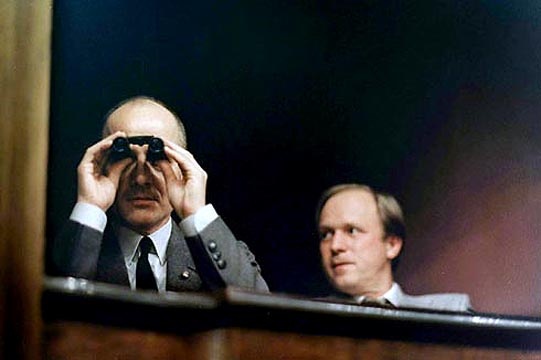
Yes, it is in German, but this film is set during one of the most infamous periods of German history. No, not the war.
During the 1980s, everything was nice for people in the UK. Oh wait, we had mass unemployment, mass riots, the Falklands war and Margaret Thatcher in office. Could have been worse. You could have been living in East Germany, where the Stasi (East German Secret Police) could have bugged your house without you knowing. That's socialism for you.
This is probably the shortest review in this countdown, but there isn't much to say, other than this is one of the most important and best films ever made in the history of German cinema.
In 1984, Hauptmann Gerd Wiesler (Ulrich Mühe) is ordered by his superior, Anton Grubitz (Ulrich Tukur), to monitor Georg Dreyman (Sebastian Koch), one of the country's most successful playwrights. This is because the Minister of Culture (Thomas Thieme) questions Dreyman's allegiance. Plus, he does fancy Dreyman's girlfriend, Christa-Maria Sieland (Martina Gedeck). Grubitz, thinking that the success of this mission will earn him a promotion, selects Wiesler and others agents to hide microphones in the light switches, place a camera outside, and bug the phone in Dreyman's flat. Wiesler monitors Dreyman from the attic. To start with, Dreyman looks clean, but he soon learns about Christa-Maria's affair with the Minister and her drug addiction. Meanwhile, Dreyman's friend Albert Jerska (Volmar Kleinert), who was blacklisted by the Stasi, hangs himself. This provokes Dreyman to write a report on the number of unaccounted suicides in East Germany since 1977, when the country had the second highest suicide rate in Europe. However, he wants to publish it anonymously in Der Spiegel, a periodical published in West Germany. This means using a West German typewriter (all East German typewriters were registered) and hiding in under his floorboards. This outrages the East German authorities and Wiesler's professionalism is called into question.
Mühe unfortunately died in 2007, after being diagnosed with stomach cancer. He was already seriously ill when the film won the Academy Award for Best Foreign Film. During the 80s, when he was in the theatre, the Stasi had him under surveillance. He later discovered that his wife and four other actors were informants. He does play a very powerful and confusing character. Wiesler is someone who seems to be in control, calm, emotionless and professional. An example is the opening scene, when he interviews a man about his neighbour escaping to the West. He asks for him to sit in a certain way and when he interviews him again notes that the answers are exactly the same. He also collects the cloth from the seat as an odour sample for the dogs. However, even though he works for the Stasi, Wiesler comes to see that the system is flawed and sympathizes with Dreyman.
This film was the feature film debut from Florian Henckel von Donnersmarck, who recently directed The Tourist. It is fair to say that the former is the better of the two. He was born in 1973, in Cologne, even though both his parents were from East Germany. It is a dark subject to put across on the screen, but there are some comic elements to it. This includes a scene where a student makes a joke about Erich Honecker in front of Wiesler and Grubitz. But, there are also some quite moving/powerful scenes. Near the end (I hope I am not giving too much away), a group of people are working in a sorting office. This is over 4 and a half years later and they hear on the radio the news that the Berlin Wall has collapsed. They simply get up and walk out.
There are plans for an American remake of this film, to be released in 2013. However, I don't know who is involved in it. The Americans will always see a foreign language film and think "What if we remade it, but got rid of the subtitles so everyone understands". One of the most recent examples was The Girl with the Dragon Tattoo. In 2009, there was the Swedish version, starring Noomi Rapace and directed by Niels Arden Oplev. It only cost $13 million to make, but took just took over $104 million worldwide. It won the BAFTA for Best Film Not in the English Language. Then late last year came the American version/remake directed by David Fincher, starring Rooney Mara and Daniel Craig. This one cost $90 million and took over $232 million. So, the original was more commercially successful, even if Mara was nominated at the Academy Awards for Best Actress. Apparently, the remake is more violent than the original, but I haven't seen it yet. Another film originally in Swedish but had an American remake was Tomas Alfredson's Let The Right One In (you'll know it as Let Me In). The original won the 2010 Kermode Award for Best Film; when he reviewd the remake he famously said "I've already Let The Right One In. Why would I let you in?" Last year, Alfredson directed Tinker Tailor Solder Spy.
Unfortunately, this isn't a true story, but is inspired by true events. It is superb in displaying what life was like in East Germany during the 1980s. It was probably also the influence for Rebekah Brooks and News International...

No comments:
Post a Comment
Thank you for commenting...