Monday, September 24, 2012

Short(ish) review #3

Full Metal Jacket (1987) - "In Vietnam The Wind Doesn't Blow It Sucks."

Before this film, the following directors had made successful films about the Vietnam War - Michael Cimino, Francis Ford Copppla and Oliver Stone. Now enter one of the greatest directors ever for his take - Stanley Kubrick (Dr. Strangelove, 2001: A Space Odyssey, A Clockwork Orange and The Shining).

It starts with a group of US Marine Corps recruits arriving for basic training, in preparation for the Vietnam War, including Pvt. "Joker" (Matthew Modine (The Dark Knight Rises)), Pvt. "Cowboy" (Arliss Howard) and Pvt. "Gomer Pyle" (Vincent D'Onofrio). They are to be turned into hardened marines under the supervision and threats of Gny. Sgt. Hartman (R. Lee Ermey). By the time they get to Vietnam, Joker has become a field reporter for the magazine Stars and Stripes and he eventually gets a chance for some action. The plot of this film isn't its strongest point.

Quite simply, the best thing about the film is R. Lee Ermey. He has the best lines, the best insults and is genuinely someone you wouldn't want to get on the wrong side of. The extreme close-up shots of his face are particularly scary. R. Lee Ermey was actually a sergeant in the U.S. Marines, so much of his dialogue was ad-libbed. For example:
 

Ever since, he has play other similar authority figure roles.

Matthew Modine's character represents the Jungian philosophy concerning the duality of men. Simply, he is a bit of an oxymoron; he wears a peace badge, but has the words "Born to kill" written on his helmet. He does hold both the halves together and this is perhaps his most recognisable role in a film. However, I cannot decide whether his performance is genius or rubbish. Part of me feels sorry for Vincent D'Onofrio, mainly because he had to put on 70 lb for the role of Gomer Pyle. That is still a record for the largest weight gained for a role (the previous record was 60 lb, set by Robert De Niro for Raging Bull). He is identified as the one recruit who is most likely to struggle early on. However, by the end of training, everyone is expected to have become a killing machine; Gomer Pyle is much more savage than any of them. It is reminiscent of the droogs in A Clockwork Orange and Jack Torrance in The Shining, especially the stare he gives. Adam Baldwin (no relation to Stephen or Alec) also features in his most recognisable role, as "Animal Mother".


In my opinion, one of the advantages that Vietnam War films have over WWII films is the soundtrack and being able to use popular music from around the 60s. For example in Full Metal Jacket, it begins with Johnny Wright's Hello Vietnam, in a scene where all the recruits are having their hair shaved off. It tries to be uplifting with its tune, but if you hear the whole song, it does promote the war to some extent. Other popular songs used include These Boots are Made for Walkin', Chapel of Love, Woolly Bully, Surfin' Bird and Paint It Black.

One of the major difference between this film and the other major Vietnam war films is the fact it was entirely filmed in the UK. For example, most of the Da Nang sequences were filmed on the Isle of Dogs and Parris Island was mainly on an RAF base in Cambridgeshire. It was a time when the Isle of Dogs was an urban wasteland, in contrast to it nowadays.This was mainly down to Stanley Kubrick's refusal to fly. Therefore, it's British (well, another example of transnational cinema). Others had been filmed in locations including Thailand, the Philippines, etc.

I love this film. It's near perfect; here's the problem. The first half of the film is fantastic, when they are at basic training, with R. Lee Ermey. However, it kind of goes downhill slightly afterwards, when they get to Vietnam. It is a film of two halves. It wasn't as successful as the other major Vietnam films, as they all received numerous nominations at the Oscars. Full Metal Jacket only received one nomination for its screenplay. Part of the problem I think is the fact it was released so soon after Platoon. However, the basic training scenes make it unique to the others. Stanley Kubrick is a genius; it's just a shame that his next and last film, Eyes Wide Shut, was utter crap...

Wednesday, September 19, 2012

Short(ish) review #2

Drive (2011) - "Get in. Get out. Get away."

When I first saw the poster for this film, I didn't know what to expect from it, so I unfairly didn't give it the credit or attention it deserved. Then I heard positive things about it and saw it get nominated at the BAFTAs for a brace of awards. I therefore took the plunge and decided to buy it on DVD. And, like Sherlock Holmes and Kick-Ass, I was pleasantly surprised with it. I was wrong to give it the cold shoulder.

The main character is simply know as the Driver (Ryan Gosling (Blue Valentine and The Ides of March)), who by day works part time as a stunt driver on movies and a mechanic (although he is also lined up to be a racing driver). By night, he's a getaway driver. He soon takes an affection to his new neighbour Irene (Carey Mulligan (An Education and Shame)) and her son. However, her husband Standard (Oscar Isaac) returns home after a spell in prison, only to find out he owes a group of mobsters money. The Driver decides to help him, but the heist goes wrong and he winds up with the money.

Ryan Gosling's character is someone who keeps himself to himself but is also psychotic, very much in the same way as Travis Bickle in Taxi Driver. However, we never learn the real name of the Driver. Ryan Gosling does a brilliant performance as someone who doesn't say much or show his emotions. He is also very precise when it comes to being a getaway driver; he will wait for five minutes whilst you're doing the job and anything outside the five minutes, that's your concern. Carey Mulligan gives a great supporting performance. Director Nic Winding Refn decided to cast her because she reminded him of Molly Ringwald and he always wanted to remake the John Hughes film Sixteen Candles. There are also notable supporting performances from Bryan Cranston (Malcolm in the Middle and Breaking Bad), Ron Perlman and Albert Brooks.

It is no surprise that the film has an 18 certificate - "contains strong gory violence". There is a lot of blood in this film, almost as much as in a Quentin Tarantino film. However, this should come as no surprise if you are familiar with some of Nic Winding Refn previous works, including the Pusher trilogy, Bronson and Valhalla Rising. There is a scene in which Ryan Gosling beats a guy to death in an elevator and Albert Brooks stabs somebody to death with a knife and fork. If you are squeamish, you may want to look away at those points.

Drive was only nominated for one Academy Award, Best Sound Editing, losing out to Martin's Scorsese's Hugo. How on Earth did this commercially and critically successful film miss out on a nomination for Best Picture to "Extremely Long and Incredibly Crass" and The Tree of Life. What's worse is the fact Transformers: Dark of the Moon received more nominations. Just because a film gets an Academy Award nomination doesn't mean it's any good. Apart from its acknowledgement at the BAFTAs, Nic Winding Refn won the award for Best Director at the Cannes Film Festival. The soundtrack to the film is very reminiscent of the 1980s, with its retro feel and use of synthesizers. It is worth a listen.

There are rumours of a sequel called Driven, as there is a second book to the original novel inspired the film, written by James Sallis. Nic Winding Refn and Ryan Gosling have expressed some interest in this, but you (the audience) would not want to see the same movie again. If there is to to be a second movie, it has a lot to live up to...

Saturday, September 15, 2012

Short(ish) review #1

We Need To Talk About Kevin (2011)

Previously, I gave a very short review of this film when looking back at the Oscars. Here comes a much lengthy review of it. This won't feature in my top 30, because I started that before I had even heard of or become aware of this film. However, it will definitely be in the revised top 50 or 100 or whatever number it will be. The last time I saw a film as chilling as this, that wasn't a horror film, was Taxi Driver.

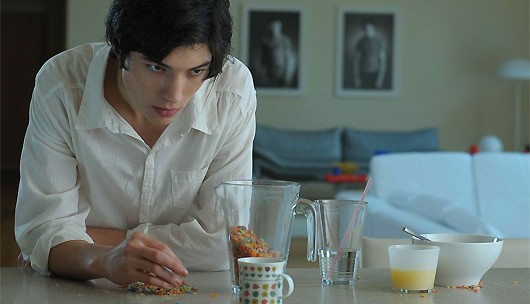
The main character of the film is Eva Khatchadourian (Tilda Swinton). She has to put aside her career as a travel writer, so that she and her husband Franklin (John C. Reilly) can have a baby. Eva gives birth to a baby son, who they call Kevin. However, it turns out there is not the best relationship between mother and son. You do feel sorry for Eva, because straightaway you see that Kevin is a little s***. As a toddler, he is silent and won't speak to her. At ages 6-8, he wets himself deliberately, he swears and he vandalises Eva's study. As a teenager (Ezra Miller), he puts a virus on Eva's computer and picks on his little sister. There is a scene where Eva goes into Kevin's room and it is so organised and so tidy, that you can only think this kid is not normal.

The film is based on the Orange Prize winning novel by Lionel Shriver. There is a quote from her on the poster - "A brilliant adaptation of my novel". This might sound like self-publicity and an over-inflated ego, but there are famous cases of authors not appreciating the film adaptation of their works. The most famous example is Stephen King's The Shining. He hated the film adaptation by Stanley Kubrick, but that is for another time. The structure of this film is one of the most interesting parts of it, the way it flickers from the present to different periods of Kevin's growing up. It is as if Eva is looking back and wondering where did it all go wrong.

This was Lynne Ramsay's first film in nine years. Back then it was Morvern Callar and in 2000, she won a BAFTA for Most Promising Newcomer for Ratcatcher. A few years ago, she was scheduled to write and direct a film adaptation of the book The Lovely Bones with Film4 Productions. However, they shutdown in July 2002 and Lynne left the project in 2004, because the producers wanted a version that was close to the source material and they felt hers wasn't. A film adaptation was made years later, directed by Peter Jackson, and it was at best flawed. For We Need To Talk About Kevin, there were budgetary difficulties which slowed production. BBC Films acquired the rights to adapt it in 2005, but because funding difficulties, filming began in April 2010 and ended just over a month later. It only cost $7 million, which doesn't seem like much compared to most films.

The film premiered at the 2011 Cannes Film Festival, where it generated positive reviews and a nomination for the Palme d'Or (losing out to The Tree of Life). There were numerous awards and nominations for Tilda Swinton, including nominations for a BAFTA and a Golden Globe. She even shared the Kermode Award for Best Actress with Olivia Coleman for her performance in Tyrannosaur. Swinton's performance is brilliant and it is good to see John C. Reilly in a serious role. However, there is a star in the making for Ezra Miller. He must have attracted the attention of a large number of directors for his portrayal of Kevin. Watch out for him in the future.

Furthermore, this is the last film that you would expect to hear a Wham song in...

Wednesday, September 12, 2012

My top 30 films - No.1

1. Monty Python's Life Of Brian (1979) - "See the movie that's controversial, sacrilegious, and blasphemous. But if that's not playing, see the Life of Brian."

"The film that is so funny it was banned in Norway". And Aberystwyth. Out of all the 30 film I have reviewed, and subsequently recommended, this is the one I would recommend the most.

As we all know, the three wisemen from the east came to Bethlehem to visit the baby Jesus when he was born. However, they initially went to the wrong stable and paid homage a baby called Brian. 33 AD, Brian (Graham Chapman) is told by his mother (Terry Jones) that his father was actually a Roman, but he wishes to deny his Roman roots and joins a Terrorist group called the People's Front of Judea. Soon afterwards, Brian escapes from Pontius Pilate (Michael Palin), but then is mistaken for the Messiah after talking about pseudo-religious truisms. He develops a group of followers who believe that everything he does is a miracle, including standing on someone's foot. The story follows the reluctant Brian through numerous biblical stories, including the Sermon on the Mount, a leper (more like an ex-leper), the feeding of the five thousand (more like a small mob with a juniper bush) and crucifixion, which itself refers to Spartacus.

.The Pythons have a reputation as one of Britain's most cherished and successful comedy troupes and Life of Brian certainly does not disappoint. The film mixes downright silliness (only Monty Python would dare to give Pontius Pilate a lisp and a friend called Biggus Dickus) with clever jokes relating to the biblical story and the that period of history (such as women going undercover as men to a stoning, from which they were banned). Despite being a regular occurrence in Python comedy, the sight of men dressed as women (in this instance themselves disguised as men) never gets old. The growing exasperation of Brian as he desperately tries to persuade his followers that he isn't the Messiah is also hilarious:

Brian: I'm not the Messiah! Will you please listen? I am not the Messiah, do you understand? Honestly!
Girl: Only the true Messiah denies His divinity.
Brian: What? Well, what sort of chance does that give me? All right! I am the Messiah!
Followers: He is! He is the Messiah!
Brian: Now, f*** off!
[silence]
Arthur (John Cleese): How shall we f*** off, O Lord?

Similar to Monty Python and the Holy Grail, the Pythons play numerous characters, about 40 between the six of them. However, it's important to acknowledge that it isn't just them. One of the mad preachers during the midpoint of the film was originally intended for Keith Moon from The Who, before he unfortunately passed away before they started shooting. The script was dedicated to him and he was looking forward to it. After the opening titles, Jesus is seen giving the Sermon on the Mount; John Cleese admitted that he originally wanted Jesus to be played by George Lazenby, just so the film could have the tagline "George Lazenby IS Jesus Christ". There are cameos in the film from Spike Milligan (who was on holiday in Tunisia whilst they were filming) and George Harrison, who actually financed the movie because EMI Films rejected it.

There is no point denying that it is one of the most controversial films ever, the 29th most according to Total Film. It was considered blasphemous and was banned in certain areas of the UK, including Aberystwyth, and various countries, including Norway and Ireland.
It inspired a debate on the BBC Two programme Friday Evening, Saturday Morning shortly after the film's release; on one side, Malcolm Muggeridge and Mervyn Stockwood, the Bishop of Southwark; the other, John Cleese and Michael Palin. Muggeridge said "I don't think, in the eyes of posterity, it will have a very distinguished place." In particular, the crucifixion scene at the end is regarded as perhaps the most controversial as the prisoners jollily sing Always Look on the Bright Side of Life. In fact, throughout the film, there is a sense of there being worse things in life than crucifixion.

I would argue that the film is not particularly blasphemous, compared to other films that do deal with the life of Jesus (for it is emphasised time and again, including by Brian himself, that he is not the Messiah). As for Malcolm Muggeridge's comments, I'm right now watching this film in the year 2012, three decades after its release. And indeed Always Look on the Bright Side of Life remains a popular funeral song. Clearly Monty Python's black sense of humour is shared by more than just me! And...if you are going to watch a controversial religious film, have the taste to make it this rather than The Da Vinci Code.

In 2007 readers of the Radio Times voted this the best British film of all time, beating the likes of Four Weddings and a Funeral, Trainspotting, The Wicker Man and Shaun of the Dead. Terry Jones said that you would not be able to make a film like it in this day and age of extreme political correctness. You can get away with far less. However, Monty Python and their films are still treasured by the British public and continue to inspire a new wave of British comedy. This film best sums me up, because, like Brian, I'm not the Messiah; I'm a very naughty boy...

Tuesday, September 4, 2012

My top 30 films - No.2

2. Shaun of the Dead (2004) - "A romantic comedy. With zombies."

"Buy milk. Call mum. Dodge zombies." Sounds like a normal daily routine.

Shaun of the Dead was written by the duo of director Edgar Wright (Scott Pilgrim vs. The World) and actor Simon Pegg (Mission: Impossible - Ghost Protocol). Together, they worked on a TV series called Asylum, a series called Is It Bill Bailey? and, most famously, the Channel 4 sitcom Spaced. The two of them both had an appreciation for the Dead trilogy by George Romero and decided to write a zombie film, inspired in some way by an episode of Spaced called Art, in which Pegg's character has been playing Resident Evil for hours and starts hallucinating zombies (this is mainly due to a combination of speed, alcohol, tiredness and Twiglets). Shaun of the Dead also features many of the same cast members as Spaced, including Pegg, Nick Frost (The Boat That Rocked and Attack The Block), Jessica Stevenson/Hynes and Peter Serafinowicz (Star Wars Episode I: The Phantom Menace), accompanied by some of Britain great comedians and comic/sitcom stars, including Dylan Moran (Black Books), Tamsin Greig (Black Books, Green Wing and Episodes), Lucy Davis and Martin Freeman (both The Office).

The plot: everyday is groundhog day for Shaun. He has an awful job as a salesman, a conflicting relationship with his mother (Penelope Wilton) and his step-father (Bill Nighy), a flatmate (Ed) who sits on a couch all day whilst dealing drugs and playing on a PlayStation and an unsatisfied girlfriend (Liz, played by Kate Ashfield). Liz dumps Shaun, mainly because she wants to live a little rather than the monotonous lifestyle of spending every night with Shaun, Ed and her flatmates (David and Dianne) in their local pub, the Winchester. The next morning, Shaun wakes up to discover a couple of zombies in his garden. It becomes clear that the same is happening everywhere, so Shaun decides to rescue both his mother and Liz and take them to the safest place he knows - The Winchester.

The film poses the question "how would you survive a zombie attack?". Shaun and Ed answer this question by arming themselves with a selection of mundane household items turned potential weapons, including cricket bats, spades and, in one memorable scene, "the second album I [Shaun] ever bought". Watching Shaun and Ed desperately arguing over records they don't mind sacrificing to fight with as two zombies edge closer is undoubtably one of the funniest scenes in the movie. The scene where the friends hide in the deserted Winchester only for the power to come back on and the jukebox to alert the zombies to their presence, leading to cinema's only zombie attack to Queen's Don't Stop Me Now, is similarly hilarious. The character of Ed provides much entertainment with a selection of amusing one-liners and utterly laid-back attitude amidst the chaos. Observant viewers will particularly enjoy his drinking plan and how it describes the subsequent events. Essentially much of the film's humour comes from its very ordinary setting, characters and relationships...but with zombies.

It is fair to say that Simon Pegg and Edgar Wright are film geeks, with Shaun of the Dead being full of references to classic horror films. The scenes of Shaun waking up in the morning are a reference to the opening of Day of the Dead; the short closeup shots of various items are from An American Werewolf in London; there are seminal electro-horror scores as a homage to John Carpenter; Dylan Moran's character was inspired by David Sumner (Dustin Hoffman) from the original Straw Dogs; there is a mention of "rage-infected monkeys" (28 Days Later...) and the title and many scenes are spoofs of Dawn of the Dead. Many non-horror films are also reference: Shaun wears a red bandanna on his head similar to Christopher Walken in The Deer Hunter; at one point Liz calls Shaun "Flash" (Flash Gordon); there is a 360-degree pan shot in the Winchester similar to one in Alien and there is a "Mexican standoff" such as the one at the end of Reservoir Dogs. This lovingly made homage to the horror/action genre is definitely one of the film's greatest strengths to the more eagle-eyed viewer.

In 2007, Pegg, Frost and Wright came back together to release Hot Fuzz, something of a modern day interpretation of The Wicker Man - small, remote community, creepy villagers. Whilst I do like Hot Fuzz, Shaun of the Dead set a high bar which I don't quite think the later film reaches. Indeed, Hot Fuzz pays homage itself to Shaun of the Dead with the infamous 'fence-scene' featuring the line "Never taken a shortcut before?" For anyone wanting to make a comedy horror film, the benchmark is so high because of Shaun of the Dead...
P.S. What was the second album you ever bought? I think mine was The Invisible Band by Travis. Edgar Wright's was "Doctor Who Sound Effects".
P.P.S. Can dogs look up?