Tuesday, February 28, 2012

My top 30 films - No.23

23. Schindler's List (1993) - "Whoever saves one life, saves the world entire."

Quite simply, there are very few films like this. No other film ever released has portrayed the plights faced by the Jews during the Holocaust better than this. It is a masterpiece from Steven Spielberg and one the greatest films ever made.

As you may well know, Oskar Schindler (Liam Neeson) was a member of the National Socialist Party and a businessman, who employed Jews to work in an enamelware factory in  Kraków, making pots and pans. This is because they cost less than Polish workers. He leaves the main administration to Izthak Stern (Ben Kingsley (Gandhi)), who ensures that as many Jews as possible get a chance to work in the factory, rather than be sent to concentration camps. Schindler also uses their contacts to procure items in order to bribe members of the SS and senior officers in the army. However, the Jews are moved to a labour camp at Paszów, which is overseen by SS-officer Amon Goeth (Ralph Fiennes (The English Patient)). Schindler convinces him to build a sub-camp for his workers, but Goeth soon receives orders to close down Paszów and ship all the Jews to Auschwitz. This is when Schindler decides to write a list of 1000 names of people to move to his hometown in Czechoslovakia and keep away from there.

I remember in GCSE English writing a piece about how the plight of the Jews during the Holocaust was depicted during The Liquidation of the Ghetto scene. I do not want to brag, but that was one of the best pieces of writing that I had ever done. The first draft was worth about a C, but I went back, re-watched that scene some many times and took note of everything that I thought was relevant. It is such a powerful and significant moment in the whole film. It is famously remembered for the shots featuring a little girl in a red coat (the only colour in the whole film). She is symbolising hope, because she is walking through the chaos of the streets, but is unnoticed by anyone apart from Schindler. During this, the audience can hear the sound of innocent children singing in the background. She then hides under a bed and the colour drains out of the coat, showing how she will soon become another victim. There is a sequence afterwards of all the remaining Jews coming out their hiding places, unaware that the Nazis are waiting for them. One particular moment features a Jew climbing out of a piano and accidentally hitting the keys before being shot. When I first watched this scene, during year 9 History, everyone in the class laughed at that moment. Looking back on that, we were a group of bastards for that.

The fact this is a monochrome film gives it a sense of place in time, also a good reference to what films of that period originally looked like. This is down to Janusz Kaminski's cinematography. It does has a documentary-style to it, but Kaminski compared it to German Expressionism and Italian Neorealism. There had to be real contrasts between characters, costumes and settings, due to the difficulty of filming a black and white film. It does feel strange in these particular films when people are either speaking Polish or German primarily, but there is also English included. It only seems to be major characters that speak English or in dramatic scenes. This is definitely Liam Neeson's best film and it makes me feel sorry for him when I see him in some blockbuster rubbish like Clash of the Titans. I also think that's good the majority of characters were played by Jews who were children of the Schlinderjuden (Schindler Jews) and there were 30,000 extras in that film.

To conclude, I would just like to say that nobody is as good at depicting the Second World War as Steven Spielberg. Not only this but he has directed masterpieces such Saving Private Ryan and been executive producer for Band Of Brothers and The Pacific. He has such a brilliant understanding of what key moments stand out and how best to portray them. One does forget that he directed this film after making Jurassic Park, so what would have happened if it was the other way round. This film, along with its amazing soundtrack, always makes me feel emotional.

By the way, my final draft for my English essay got an A*.

So Mr. Oscar, what do you really know about films?

As we all known, this Sunday saw the 84th Academy Awards and it was mainly dominated by The Artist and Hugo. Full credit to both Michel Hazanavicius and Martin Scorsese. However, let's just hope that not every director decides to copy The Artist and be a silent movie. Mind you, all of Michael Bay's films just go BOOM BANG CRASH and PHWOAR. Hugo has proven to be the only film released where 3D has made sense. Apart from that, 3D is dead as far as I'm concerned. That's what happens when more people go and see Pirates of the Caribbean: On Stranger Tides in 2D than 3D, The Hangover: Part II does better at the box office than 3D films and directors re-release classic films (The Lion King and Star Wars) and crap (Titanic) in 3D. It's the same film as before, but now the audience has to wear a pair of stupid glasses.

Going back to the Academy Awards, as always they get things wrong. It is disappointing that Tinker Tailor Soldier Spy didn't get the satisfaction it deserved. It missed out on Best Adapted Screenplay to The Descendants, but at least Gary Oldman was nominated for Best Actor. It was a long overdue nomination for an actor as professional as him. That wasn't the biggest oversight of these awards.

Why, for crying out loud, wasn't Senna even in the long list for Best Documentary? Clearly, it was the best documentary of the year and thank God it was recognised at the BAFTAs, winning Best Documentary and Best Editing. Personally, it was my favourite film of the year. It is about so much more than Formula 1 and I love the fact that it isn't just about racing. It concentrates on the difficult relationship between Ayrton Senna and Alain Prost. In the final third or so of the film, I was silent. I didn't want to make any noise, because I knew what was coming. The film is a brilliant tribute to the greatest driver ever.

Also, We Need To Talk About Kevin wasn't nominated for anything at the Academy Awards. At the BAFTAs it was nominated for Best Director (Lynne Ramsey), Best British Film and Best Actress (Tilda Swinton). I saw it for the first time today and I thought it was chilling, especially Ezra Miller's performance, well directed and very red. That's a compliment It is also a fantastic lead performance from Tilda Swinton and good to see John C. Reilly in a serious role. If you watch it from the beginning and find it difficult to understand because there are bits from different times, don't worry; it will make sense in the end. Plus, I like the line "Why would I not know the context? I am the context." What I love though is a comment on the poster and DVD box from Lionel Shriver: "A Brilliant adaptation of my novel". Self publicity.

These are two grave omissions from the Academy Awards, which is why what they don't recognise the Kermode Awards do. The Kermode Awards, named after the BBC film critic Mark Kermode, are awarded to films and individuals every year. There is one main rule: you cannot win a Kermode for a category that you've been nominated in for an Oscar. Previous winners of Kermode Awards in the past have included Jonny Greenwood (Best Music Score 2008 - There Will Be Blood), David Cronenberg (Best Director 2008 - Eastern Promises), Andy Serkis (Best Actor 2010 - Sex & Drugs & Rock & Roll), William Ivory (Best Screenplay 2011 - Made In Dagenham) and most famously Christopher Nolan (Best Director 2011 - Inception). Here is the list of winners of the 2012 Kermode Awards:
  • Best Musical - Benda Billili
  • Best Documentary - Senna
  • Best Actress - Olivia Colman (Tyrannosaur) and Tilda Swinton (We Need To Talk About Kevin)
  • Best Actor - Michael Fassbender (Shame)
  • Best Director - Lynne Ramsey (We Need To Talk About Kevin)
  • Best Film - We Need To Talk About Kevin
This is where you can voice your opinion. What I would like to know from all of you is what do think are the best films/actors/actresses/directors/etc. that the Academy Awards have neglected. For example, The Shawshank Redemption may be the greatest film ever, but it did not win a single Oscar. So, you can leave your nominations in the comments box below. Whatever you put, it must be better than either Titanic or Driving Miss Daisy.

This has been corrected on 10th April 2012 due to poor research. Apologies. The original source will be cast into a deep pit filled with needles.


Saturday, February 4, 2012

My top 30 films - No.24

24. Local Hero (1983)
 
Out of all the films in this countdown, this was always going to be in there. Come on, I first saw this when I was seven.

Local Hero was written and directed by Bill Forsyth (Gregory's Girl) and produced by David Puttnam (Chariots Of Fire). It starts in Houston, Texas, where the owner of Knox Oil and Gas Felix Happer (Burt Lancaster (Birdman of Alcatraz)) decides to send "Mac" MacIntyre (Peter Riegert (The Mask)) on a business trip to Scotland to buy the fictional village of Ferness and the stretch of coastline nearby, making all the residents millionaires. The reason they want to buy it - to turn it into a refinery. The reason he chooses Mac - his name sounds Scottish. Before leaving, Happer asks Mac to watch the sky, especially around the constellation of Virgo, and report any unusual activity. He arrives in Scotland and is met by Danny Oldsen (Peter Capaldi (The Thick Of It and In The Loop)), who drives him to Ferness. However, they end up stopping in the middle of fog, after having ran over a rabbit. That scene is fantastic, particularly when Danny goes "Should we put it out of its misery...Kill it. Hit it with something hard" and Mac simply replies "You've already done that with a 2 tonne automobile." They arrive in Ferness the following morning and try to check into a hotel, but are told "breakfast isn't until 8; 7 in the fishing season. It's not the fishing season." Mac's reply - "We have an injured rabbit also." The man they are looking for to discuss the deal is actually the owner of the hotel - Gordon Urquhart (Denis Lawson (Star Wars)). All the locals want the deal to go through, so they can get "4 or 5 winter lambs and a box of mackerel into the back of a Maserati". However, there is a problem concerning the nearby beach and the man who lives on it called Ben (Fulton Mackay (Porridge)).

Local Hero is brilliantly written and features some memorable quotes. There is one particular moment where one of the locals is naming his boat The Silver Dollar and someone asks him "Are you sure there are two L's in dollar, Gideon?" His response is priceless - "Yes. An' are there two G's in bugger off?" There are two other scenes that are memorable in this film. The first one happens at the end of the ceilidh, where Mac is quite drunk and offers to swap lives with Gordon. He is prepare to give away his apartment in Houston, his job and his Porsche to Gordon, so that he can stay in Ferness. The other is when Mac is negotiating with Ben and Ben picks up a handful of sand. He tells Mac that he can pay him £1 for every grain of sand in his hand and he'll sell the beach for it. The best bit of this is when some fall through his finger, saving him a few pounds. Is it a comedy? Most of the comic elements of based on reality. Honestly, go to a village in Northern Scotland and there will be one man constantly going up and down the street on a motorbike.

The most amazing thing concerning the cast was the fact they were able to have a Hollywood star like Burt Lancaster appear in it. He joined after Bill Forsyth won the BAFTA for Best Original Screenplay for Gregory's Girl and David Puttnam a BAFTA and an Oscar for Best Film for Chariots of Fire. Apparently one-third of the budget was Burt Lancaster's wages. He was the only major Hollywood star in the film. Peter Riegert was little-known at the time but was Bill Forsyth's choice, even though Warner Bros. would have preferred Henry Winkler. The sense of Mac constantly walking into room and going "HEY!" like the Fonz doesn't seem right. And who would have thought that an inexperienced Peter Capaldi would become the violent, foul-mouthed Malcolm Tucker.

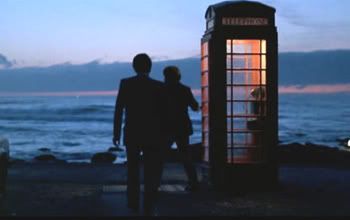
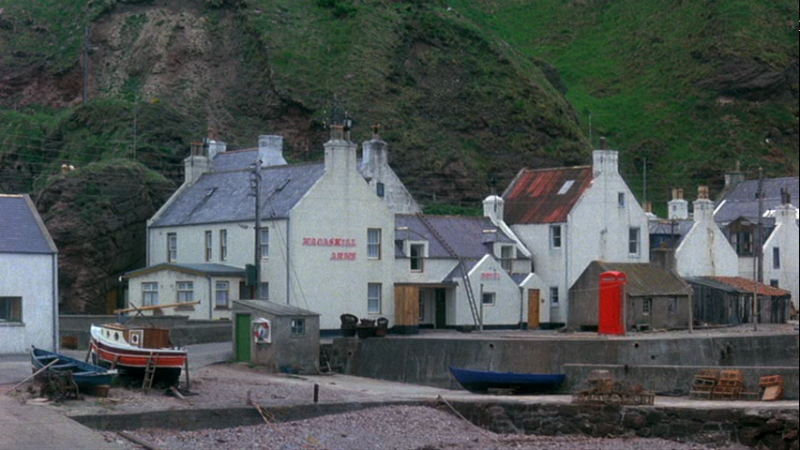
The other thing to love is the setting of the movie. The Ferness scenes were filmed in Pennan, Aberdeenshire. Honestly, if you go there after watching the movie, you will see that it hasn't changed one bit. Well, I say that, but one thing has changed. An important part of the film is the phonebox which Mac uses whenever he wants to call America. The actual phonebox in Pennan is not the same one used in the film; they built a wooden one yards away. The beach scenes were actually shot on the other side of Scotland, on the west coast at Arisaig, Morar and Camusterrach. I remember visiting those beaches in 1999 and 2000. Good times. It is picturesque and worth visiting, preferable in the summer. This film is an advert for Visit Scotland.

Finally, a word on the soundtrack - fantastic. The soundtrack was composed by the legendary Mark Knopfler from Dire Straits. The main tune is performed in so many different ways but they work on every level. There is a piano/acoustic guitar version (known as the Wild Theme), a version played by The Acetones during the ceilidh and Northern Lights scene and, of course, Going Home, which is played during the end credits. Going Home is also the intro music for Newcastle United's home games. That's why it is just as special for me. The whole soundtrack perfectly compliments the movie with its instrumental melodies, even though the soundtrack actually outsold the movie.

Back in 2008, Mark Kermode did a piece for The Culture Show, where he took Bill Forsyth back to Pennan to celebrate the film's 25th anniversary. The most special moment of that was a screening of the film in the newly reopened village hall (which had been destroyed by a mudslide the previous year) and Bill Forsyth admitted that this was the first time he had watched the film in 23 years. He won a BAFTA for Best Direction and the film was nominated for 5 others categories, including Best Film. This is almost the perfect movie. Sure there are things that Warner Bros. and maybe other directors would have done differently. But if they had, I wouldn't be talking about this film and you wouldn't be reading about it...

Friday, February 3, 2012

My top 30 films - No.25

25. The Breakfast Club (1985) - "They only met once, but it changed their lives forever."

Teen genre movies have been around since the mid 1950s and early 1960s, similar to rock 'n' roll. In that time, they were rebellious (James Dean, 1955) with quirky music in them. That was when teenagers first came into existence. It focused on the stereotypical image of teenagers at the time, as epitomized by their portrayal in A Hard Day's Night (screaming at The Beatles). During the 70s, teenagers got more involved in horror movies featuring blood, slaughter and violence; these included The Last House On The Left, Halloween and The Texas Chainsaw Massacre. They wanted to be scared. This continued into the 80s with Friday The 13th and A Nightmare On Elm Street, but that decade saw the revolution of the genre. The man responsible started this in 1984 with Sixteen Candles, but it is his work the following year which is in my opinion the definitive work of the genre. The guy understands teenagers and how they think and speak. I give you John Hughes and The Breakfast Club.

The Breakfast Club concentrates on five kids who represent the typical stereotypes you would find in any school: the brain - Brian Johnson (Anthony Michael Hall), the beauty - Claire Standish (Molly Ringwald), the jock - Andrew Clark (Emilio Estevez), the rebel - John Bender (Judd Nelson) and the reckless - Allison Reynolds (Ally Sheedy). They have nothing in common, but are all forced to report for Saturday detention by vice-principal Richard Vernon (John Gleason). He tells them to write a 1000 word essay about who each of them think they are in eight hours, fifty-four minutes. As you can guess, they don't. I want give away too much of the plot, but at the beginning they have nothing to say to each other. However by the end, they have become friends and reveal their secrets and why they are in detention, even though they may never talk to each other again.

John Hughes gives these characters real personalities. They are so much more than just individuals who represent each social group. They come to learn that each of them is similar in the sense that they have strained relationships with their parents. At the end of it, they realize that they impressions of each has changed. That's why the film starts and ends with a letter, as it shows how the characters have changed. The actors brilliantly represent each stereotype, especially Judd Nelson as the criminal that is John Bender. You do feel at the beginning that he seems to be a complete arse, but he does show his human side later. Supposedly he stayed in character off screen as well. His best moment has to be the closing scene with him walking across the football pitch and punching the air.

In my opinion, this is no only the definitive teen movie but it is also the definitive high school movie. Others would say Heathers, Election starring Matthew Broderick or Richard Linklater's Dazed and Confused. My dad remembers watching If...., starring Malcolm McDowell, when he was younger and does have a copy of Bill Forsyth's Gregory's Girl at home. Gregory's Girl has some classic moments in it, especially the opening scene (which sums up all teenage boys), two of the characters trying to hitchhike to Caracas to find love and the main character weaving across the playground like an idiot, with the teachers watching him. Anything modern is rubbish, especially High School Musical. Honestly, put those people in the real world and they'd be dead within 12 hours. The only good modern high school movie has to be School Of Rock. Teen movies since the 90s seen to concentrated mostly on image, drugs, booze, sex and all those related themes. Most of them are a bit crass and not as funny as they make out to be. To all those fans of American Pie and Superbad, those films would never have existed if it wasn't for The Breakfast Club. You would not get this quote in any of those - "Does Barry Manilow know that you raid his wardrobe?" It is the genre-defining movie and always will be.

P.S. The main theme for this film was Don't You (Forget About Me) by Simple Minds and that works perfectly for this movie. It is Simple Minds' greatest song and is the definitive 80s song for the the definitive 80s movie.