Saturday, November 17, 2012

Short(ish) review #4

Goodfellas (1990) - "Three Decades of Life in the Mafia."

Which is better - The Godfather or Goodfellas? Both give accurate depictions of life in the Mafia. Both are highly regarded as two of the greatest films of all time. But Goodfellas is more laid back and light-hearted.

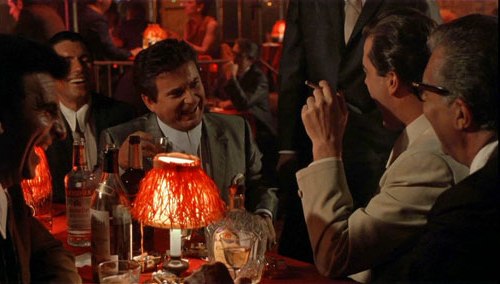
Spanning from 1955 to 1980, Goodfellas follows the real life story of Henry Hill (Ray Liotta (Killing Them Softly)), who from the age of 12 always wanted to be a gangster. Rather than go to school, he parks cars and runs errands for the Lucchese family. He is taken under the wing of Paul Cicero (Paul Sorvino), who introduces him to Jimmy Conway (Robert De Niro (Mean Streets, Taxi Driver and Raging Bull)). In the 60s, Henry, along with Jimmy and Tommy DeVito (Joe Pesci (Raging Bull, Home Alone and Casino)), makes a name for himself with the Air France Robbery. He then falls in love with a Jewish girl called Karen (Lorraine Bracco), who is aroused when Henry comes to her defence. By 1980, Henry is a paranoid drug addict, who keep thinking that the police are following him.

The main advantage I would say that Goodfellas has over the The Godfather is the director, Martin Scorsese. Scorsese came from Italian descent and put some of his own experiences in his breakthrough film Mean Streets and this kind of follows on from it. This was originally adapted from Nicholas Pileggi's book Wiseguy, who also worked on the screenplay. Scorsese chooses to use a scene halfway in the book as the introduction. It is amazing some of the work that Martin Scorsese can do, because the scene where Henry and Karen go to the Copacabana Club through the back is only about two lines in the book. Scorsese follows them for 2 or 3 minutes with a steady cam, going along corridors and through a busy kitchen. It's brilliant. Scorsese is a genius and that short moment that he picked up on in the book became one of the greatest shots in movie history. Mind you, it must have been a nightmare to film.


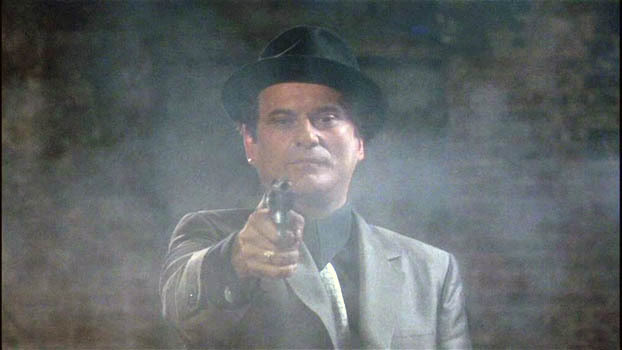
The best performance in the film is clearly Joe Pesci as Tommy. He is a mindless psychopath, but you cannot help but laugh at some of his comments. He's a funny guy, but don't tell him I said that because you know what's coming - "I'm funny how, I mean funny like I'm a clown, I amuse you? I make you laugh, I'm here to f***in' amuse you? What do you mean funny, funny how? How am I funny?" He won the Academy Award for Best Supporting Actor, giving one of the shortest acceptance speeches ever. Of course being a Martin Scorsese film, it has Robert De Niro in it. It is another great performance from him, but unlike most of the films he has made with Martin Scorsese, he's in more of a supporting role this time round, compared to Taxi Driver, Raging Bull, Cape Fear, etc. It is also Ray Liotta's best performance and he's very much underrated in this film, despite being the main protagonist. His performance in this film, to me, looks similar to his most recent film Killing Them Softly, which i really want to see. There is even a cameo appearance from Martin Scorsese's mother.
The soundtrack to this film is brilliant as well. It features a number of classic hits from the 1950s, 60s and 70s, most of which contrast as the years go on. You have the smooth sounds of Tony Bennett and Bobby Darin, the relaxing Atlantis by Donovan, the classic instrumental ending of Layla by Eric Clapton and the chaos and barrage of noise that is Sid Vicious murdering Frank Sinatra's My Way (in a good way).

Don't get me wrong. I love The Godfather and think that Francis Ford Coppola did a great job making it. However, for me Martin Scorsese just edges this with another example of why he is perhaps the greatest director of all time.

N.B. There is a Goodfellas drinking game. You choose a character at random and whenever your character swears, you have to take a drink. So whoever is Joe Pesci, you're f***ed...

Monday, September 24, 2012

Short(ish) review #3

Full Metal Jacket (1987) - "In Vietnam The Wind Doesn't Blow It Sucks."

Before this film, the following directors had made successful films about the Vietnam War - Michael Cimino, Francis Ford Copppla and Oliver Stone. Now enter one of the greatest directors ever for his take - Stanley Kubrick (Dr. Strangelove, 2001: A Space Odyssey, A Clockwork Orange and The Shining).

It starts with a group of US Marine Corps recruits arriving for basic training, in preparation for the Vietnam War, including Pvt. "Joker" (Matthew Modine (The Dark Knight Rises)), Pvt. "Cowboy" (Arliss Howard) and Pvt. "Gomer Pyle" (Vincent D'Onofrio). They are to be turned into hardened marines under the supervision and threats of Gny. Sgt. Hartman (R. Lee Ermey). By the time they get to Vietnam, Joker has become a field reporter for the magazine Stars and Stripes and he eventually gets a chance for some action. The plot of this film isn't its strongest point.

Quite simply, the best thing about the film is R. Lee Ermey. He has the best lines, the best insults and is genuinely someone you wouldn't want to get on the wrong side of. The extreme close-up shots of his face are particularly scary. R. Lee Ermey was actually a sergeant in the U.S. Marines, so much of his dialogue was ad-libbed. For example:
 

Ever since, he has play other similar authority figure roles.

Matthew Modine's character represents the Jungian philosophy concerning the duality of men. Simply, he is a bit of an oxymoron; he wears a peace badge, but has the words "Born to kill" written on his helmet. He does hold both the halves together and this is perhaps his most recognisable role in a film. However, I cannot decide whether his performance is genius or rubbish. Part of me feels sorry for Vincent D'Onofrio, mainly because he had to put on 70 lb for the role of Gomer Pyle. That is still a record for the largest weight gained for a role (the previous record was 60 lb, set by Robert De Niro for Raging Bull). He is identified as the one recruit who is most likely to struggle early on. However, by the end of training, everyone is expected to have become a killing machine; Gomer Pyle is much more savage than any of them. It is reminiscent of the droogs in A Clockwork Orange and Jack Torrance in The Shining, especially the stare he gives. Adam Baldwin (no relation to Stephen or Alec) also features in his most recognisable role, as "Animal Mother".


In my opinion, one of the advantages that Vietnam War films have over WWII films is the soundtrack and being able to use popular music from around the 60s. For example in Full Metal Jacket, it begins with Johnny Wright's Hello Vietnam, in a scene where all the recruits are having their hair shaved off. It tries to be uplifting with its tune, but if you hear the whole song, it does promote the war to some extent. Other popular songs used include These Boots are Made for Walkin', Chapel of Love, Woolly Bully, Surfin' Bird and Paint It Black.

One of the major difference between this film and the other major Vietnam war films is the fact it was entirely filmed in the UK. For example, most of the Da Nang sequences were filmed on the Isle of Dogs and Parris Island was mainly on an RAF base in Cambridgeshire. It was a time when the Isle of Dogs was an urban wasteland, in contrast to it nowadays.This was mainly down to Stanley Kubrick's refusal to fly. Therefore, it's British (well, another example of transnational cinema). Others had been filmed in locations including Thailand, the Philippines, etc.

I love this film. It's near perfect; here's the problem. The first half of the film is fantastic, when they are at basic training, with R. Lee Ermey. However, it kind of goes downhill slightly afterwards, when they get to Vietnam. It is a film of two halves. It wasn't as successful as the other major Vietnam films, as they all received numerous nominations at the Oscars. Full Metal Jacket only received one nomination for its screenplay. Part of the problem I think is the fact it was released so soon after Platoon. However, the basic training scenes make it unique to the others. Stanley Kubrick is a genius; it's just a shame that his next and last film, Eyes Wide Shut, was utter crap...

Wednesday, September 19, 2012

Short(ish) review #2

Drive (2011) - "Get in. Get out. Get away."

When I first saw the poster for this film, I didn't know what to expect from it, so I unfairly didn't give it the credit or attention it deserved. Then I heard positive things about it and saw it get nominated at the BAFTAs for a brace of awards. I therefore took the plunge and decided to buy it on DVD. And, like Sherlock Holmes and Kick-Ass, I was pleasantly surprised with it. I was wrong to give it the cold shoulder.

The main character is simply know as the Driver (Ryan Gosling (Blue Valentine and The Ides of March)), who by day works part time as a stunt driver on movies and a mechanic (although he is also lined up to be a racing driver). By night, he's a getaway driver. He soon takes an affection to his new neighbour Irene (Carey Mulligan (An Education and Shame)) and her son. However, her husband Standard (Oscar Isaac) returns home after a spell in prison, only to find out he owes a group of mobsters money. The Driver decides to help him, but the heist goes wrong and he winds up with the money.

Ryan Gosling's character is someone who keeps himself to himself but is also psychotic, very much in the same way as Travis Bickle in Taxi Driver. However, we never learn the real name of the Driver. Ryan Gosling does a brilliant performance as someone who doesn't say much or show his emotions. He is also very precise when it comes to being a getaway driver; he will wait for five minutes whilst you're doing the job and anything outside the five minutes, that's your concern. Carey Mulligan gives a great supporting performance. Director Nic Winding Refn decided to cast her because she reminded him of Molly Ringwald and he always wanted to remake the John Hughes film Sixteen Candles. There are also notable supporting performances from Bryan Cranston (Malcolm in the Middle and Breaking Bad), Ron Perlman and Albert Brooks.

It is no surprise that the film has an 18 certificate - "contains strong gory violence". There is a lot of blood in this film, almost as much as in a Quentin Tarantino film. However, this should come as no surprise if you are familiar with some of Nic Winding Refn previous works, including the Pusher trilogy, Bronson and Valhalla Rising. There is a scene in which Ryan Gosling beats a guy to death in an elevator and Albert Brooks stabs somebody to death with a knife and fork. If you are squeamish, you may want to look away at those points.

Drive was only nominated for one Academy Award, Best Sound Editing, losing out to Martin's Scorsese's Hugo. How on Earth did this commercially and critically successful film miss out on a nomination for Best Picture to "Extremely Long and Incredibly Crass" and The Tree of Life. What's worse is the fact Transformers: Dark of the Moon received more nominations. Just because a film gets an Academy Award nomination doesn't mean it's any good. Apart from its acknowledgement at the BAFTAs, Nic Winding Refn won the award for Best Director at the Cannes Film Festival. The soundtrack to the film is very reminiscent of the 1980s, with its retro feel and use of synthesizers. It is worth a listen.

There are rumours of a sequel called Driven, as there is a second book to the original novel inspired the film, written by James Sallis. Nic Winding Refn and Ryan Gosling have expressed some interest in this, but you (the audience) would not want to see the same movie again. If there is to to be a second movie, it has a lot to live up to...

Saturday, September 15, 2012

Short(ish) review #1

We Need To Talk About Kevin (2011)

Previously, I gave a very short review of this film when looking back at the Oscars. Here comes a much lengthy review of it. This won't feature in my top 30, because I started that before I had even heard of or become aware of this film. However, it will definitely be in the revised top 50 or 100 or whatever number it will be. The last time I saw a film as chilling as this, that wasn't a horror film, was Taxi Driver.

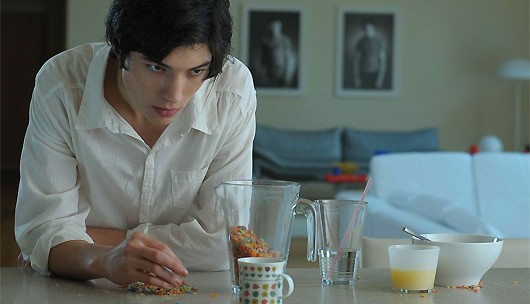
The main character of the film is Eva Khatchadourian (Tilda Swinton). She has to put aside her career as a travel writer, so that she and her husband Franklin (John C. Reilly) can have a baby. Eva gives birth to a baby son, who they call Kevin. However, it turns out there is not the best relationship between mother and son. You do feel sorry for Eva, because straightaway you see that Kevin is a little s***. As a toddler, he is silent and won't speak to her. At ages 6-8, he wets himself deliberately, he swears and he vandalises Eva's study. As a teenager (Ezra Miller), he puts a virus on Eva's computer and picks on his little sister. There is a scene where Eva goes into Kevin's room and it is so organised and so tidy, that you can only think this kid is not normal.

The film is based on the Orange Prize winning novel by Lionel Shriver. There is a quote from her on the poster - "A brilliant adaptation of my novel". This might sound like self-publicity and an over-inflated ego, but there are famous cases of authors not appreciating the film adaptation of their works. The most famous example is Stephen King's The Shining. He hated the film adaptation by Stanley Kubrick, but that is for another time. The structure of this film is one of the most interesting parts of it, the way it flickers from the present to different periods of Kevin's growing up. It is as if Eva is looking back and wondering where did it all go wrong.

This was Lynne Ramsay's first film in nine years. Back then it was Morvern Callar and in 2000, she won a BAFTA for Most Promising Newcomer for Ratcatcher. A few years ago, she was scheduled to write and direct a film adaptation of the book The Lovely Bones with Film4 Productions. However, they shutdown in July 2002 and Lynne left the project in 2004, because the producers wanted a version that was close to the source material and they felt hers wasn't. A film adaptation was made years later, directed by Peter Jackson, and it was at best flawed. For We Need To Talk About Kevin, there were budgetary difficulties which slowed production. BBC Films acquired the rights to adapt it in 2005, but because funding difficulties, filming began in April 2010 and ended just over a month later. It only cost $7 million, which doesn't seem like much compared to most films.

The film premiered at the 2011 Cannes Film Festival, where it generated positive reviews and a nomination for the Palme d'Or (losing out to The Tree of Life). There were numerous awards and nominations for Tilda Swinton, including nominations for a BAFTA and a Golden Globe. She even shared the Kermode Award for Best Actress with Olivia Coleman for her performance in Tyrannosaur. Swinton's performance is brilliant and it is good to see John C. Reilly in a serious role. However, there is a star in the making for Ezra Miller. He must have attracted the attention of a large number of directors for his portrayal of Kevin. Watch out for him in the future.

Furthermore, this is the last film that you would expect to hear a Wham song in...

Wednesday, September 12, 2012

My top 30 films - No.1

1. Monty Python's Life Of Brian (1979) - "See the movie that's controversial, sacrilegious, and blasphemous. But if that's not playing, see the Life of Brian."

"The film that is so funny it was banned in Norway". And Aberystwyth. Out of all the 30 film I have reviewed, and subsequently recommended, this is the one I would recommend the most.

As we all know, the three wisemen from the east came to Bethlehem to visit the baby Jesus when he was born. However, they initially went to the wrong stable and paid homage a baby called Brian. 33 AD, Brian (Graham Chapman) is told by his mother (Terry Jones) that his father was actually a Roman, but he wishes to deny his Roman roots and joins a Terrorist group called the People's Front of Judea. Soon afterwards, Brian escapes from Pontius Pilate (Michael Palin), but then is mistaken for the Messiah after talking about pseudo-religious truisms. He develops a group of followers who believe that everything he does is a miracle, including standing on someone's foot. The story follows the reluctant Brian through numerous biblical stories, including the Sermon on the Mount, a leper (more like an ex-leper), the feeding of the five thousand (more like a small mob with a juniper bush) and crucifixion, which itself refers to Spartacus.

.The Pythons have a reputation as one of Britain's most cherished and successful comedy troupes and Life of Brian certainly does not disappoint. The film mixes downright silliness (only Monty Python would dare to give Pontius Pilate a lisp and a friend called Biggus Dickus) with clever jokes relating to the biblical story and the that period of history (such as women going undercover as men to a stoning, from which they were banned). Despite being a regular occurrence in Python comedy, the sight of men dressed as women (in this instance themselves disguised as men) never gets old. The growing exasperation of Brian as he desperately tries to persuade his followers that he isn't the Messiah is also hilarious:

Brian: I'm not the Messiah! Will you please listen? I am not the Messiah, do you understand? Honestly!
Girl: Only the true Messiah denies His divinity.
Brian: What? Well, what sort of chance does that give me? All right! I am the Messiah!
Followers: He is! He is the Messiah!
Brian: Now, f*** off!
[silence]
Arthur (John Cleese): How shall we f*** off, O Lord?

Similar to Monty Python and the Holy Grail, the Pythons play numerous characters, about 40 between the six of them. However, it's important to acknowledge that it isn't just them. One of the mad preachers during the midpoint of the film was originally intended for Keith Moon from The Who, before he unfortunately passed away before they started shooting. The script was dedicated to him and he was looking forward to it. After the opening titles, Jesus is seen giving the Sermon on the Mount; John Cleese admitted that he originally wanted Jesus to be played by George Lazenby, just so the film could have the tagline "George Lazenby IS Jesus Christ". There are cameos in the film from Spike Milligan (who was on holiday in Tunisia whilst they were filming) and George Harrison, who actually financed the movie because EMI Films rejected it.

There is no point denying that it is one of the most controversial films ever, the 29th most according to Total Film. It was considered blasphemous and was banned in certain areas of the UK, including Aberystwyth, and various countries, including Norway and Ireland.
It inspired a debate on the BBC Two programme Friday Evening, Saturday Morning shortly after the film's release; on one side, Malcolm Muggeridge and Mervyn Stockwood, the Bishop of Southwark; the other, John Cleese and Michael Palin. Muggeridge said "I don't think, in the eyes of posterity, it will have a very distinguished place." In particular, the crucifixion scene at the end is regarded as perhaps the most controversial as the prisoners jollily sing Always Look on the Bright Side of Life. In fact, throughout the film, there is a sense of there being worse things in life than crucifixion.

I would argue that the film is not particularly blasphemous, compared to other films that do deal with the life of Jesus (for it is emphasised time and again, including by Brian himself, that he is not the Messiah). As for Malcolm Muggeridge's comments, I'm right now watching this film in the year 2012, three decades after its release. And indeed Always Look on the Bright Side of Life remains a popular funeral song. Clearly Monty Python's black sense of humour is shared by more than just me! And...if you are going to watch a controversial religious film, have the taste to make it this rather than The Da Vinci Code.

In 2007 readers of the Radio Times voted this the best British film of all time, beating the likes of Four Weddings and a Funeral, Trainspotting, The Wicker Man and Shaun of the Dead. Terry Jones said that you would not be able to make a film like it in this day and age of extreme political correctness. You can get away with far less. However, Monty Python and their films are still treasured by the British public and continue to inspire a new wave of British comedy. This film best sums me up, because, like Brian, I'm not the Messiah; I'm a very naughty boy...

Tuesday, September 4, 2012

My top 30 films - No.2

2. Shaun of the Dead (2004) - "A romantic comedy. With zombies."

"Buy milk. Call mum. Dodge zombies." Sounds like a normal daily routine.

Shaun of the Dead was written by the duo of director Edgar Wright (Scott Pilgrim vs. The World) and actor Simon Pegg (Mission: Impossible - Ghost Protocol). Together, they worked on a TV series called Asylum, a series called Is It Bill Bailey? and, most famously, the Channel 4 sitcom Spaced. The two of them both had an appreciation for the Dead trilogy by George Romero and decided to write a zombie film, inspired in some way by an episode of Spaced called Art, in which Pegg's character has been playing Resident Evil for hours and starts hallucinating zombies (this is mainly due to a combination of speed, alcohol, tiredness and Twiglets). Shaun of the Dead also features many of the same cast members as Spaced, including Pegg, Nick Frost (The Boat That Rocked and Attack The Block), Jessica Stevenson/Hynes and Peter Serafinowicz (Star Wars Episode I: The Phantom Menace), accompanied by some of Britain great comedians and comic/sitcom stars, including Dylan Moran (Black Books), Tamsin Greig (Black Books, Green Wing and Episodes), Lucy Davis and Martin Freeman (both The Office).

The plot: everyday is groundhog day for Shaun. He has an awful job as a salesman, a conflicting relationship with his mother (Penelope Wilton) and his step-father (Bill Nighy), a flatmate (Ed) who sits on a couch all day whilst dealing drugs and playing on a PlayStation and an unsatisfied girlfriend (Liz, played by Kate Ashfield). Liz dumps Shaun, mainly because she wants to live a little rather than the monotonous lifestyle of spending every night with Shaun, Ed and her flatmates (David and Dianne) in their local pub, the Winchester. The next morning, Shaun wakes up to discover a couple of zombies in his garden. It becomes clear that the same is happening everywhere, so Shaun decides to rescue both his mother and Liz and take them to the safest place he knows - The Winchester.

The film poses the question "how would you survive a zombie attack?". Shaun and Ed answer this question by arming themselves with a selection of mundane household items turned potential weapons, including cricket bats, spades and, in one memorable scene, "the second album I [Shaun] ever bought". Watching Shaun and Ed desperately arguing over records they don't mind sacrificing to fight with as two zombies edge closer is undoubtably one of the funniest scenes in the movie. The scene where the friends hide in the deserted Winchester only for the power to come back on and the jukebox to alert the zombies to their presence, leading to cinema's only zombie attack to Queen's Don't Stop Me Now, is similarly hilarious. The character of Ed provides much entertainment with a selection of amusing one-liners and utterly laid-back attitude amidst the chaos. Observant viewers will particularly enjoy his drinking plan and how it describes the subsequent events. Essentially much of the film's humour comes from its very ordinary setting, characters and relationships...but with zombies.

It is fair to say that Simon Pegg and Edgar Wright are film geeks, with Shaun of the Dead being full of references to classic horror films. The scenes of Shaun waking up in the morning are a reference to the opening of Day of the Dead; the short closeup shots of various items are from An American Werewolf in London; there are seminal electro-horror scores as a homage to John Carpenter; Dylan Moran's character was inspired by David Sumner (Dustin Hoffman) from the original Straw Dogs; there is a mention of "rage-infected monkeys" (28 Days Later...) and the title and many scenes are spoofs of Dawn of the Dead. Many non-horror films are also reference: Shaun wears a red bandanna on his head similar to Christopher Walken in The Deer Hunter; at one point Liz calls Shaun "Flash" (Flash Gordon); there is a 360-degree pan shot in the Winchester similar to one in Alien and there is a "Mexican standoff" such as the one at the end of Reservoir Dogs. This lovingly made homage to the horror/action genre is definitely one of the film's greatest strengths to the more eagle-eyed viewer.

In 2007, Pegg, Frost and Wright came back together to release Hot Fuzz, something of a modern day interpretation of The Wicker Man - small, remote community, creepy villagers. Whilst I do like Hot Fuzz, Shaun of the Dead set a high bar which I don't quite think the later film reaches. Indeed, Hot Fuzz pays homage itself to Shaun of the Dead with the infamous 'fence-scene' featuring the line "Never taken a shortcut before?" For anyone wanting to make a comedy horror film, the benchmark is so high because of Shaun of the Dead...
P.S. What was the second album you ever bought? I think mine was The Invisible Band by Travis. Edgar Wright's was "Doctor Who Sound Effects".
P.P.S. Can dogs look up?

Tuesday, August 28, 2012

My top 30 films - No.3

3. Toy Story 3 (2010) - "No toy gets left behind."

The film that made grown men cry. This was the one film I was looking forward to so much in 2010. I, like millions of teenagers and people in their early 20s, had been waiting for this film for 11 years. We all had high hopes and expectations and it failed to disappoint. My sister did warn me in advance to take a packet of tissues with me, because when she saw it the whole cinema, even the ushers, were in tears. I must admit it; it was a little emotional when I first saw it and I did my best to hide it with my most manly of coughs. I am guessing that there was a lot of that. The second time, I was a blubbering wreck.

In this film (assuming that you know who the characters are from the previous two films), the toys haven't been played with for several years and Andy is leaving for college. He doesn't know what he wants to do with: put them in the trash, put them in the attic, give them away or take them with him? He decides that he wants to take Woody (Tom Hanks (Philadelphia, Forrest Gump and Saving Private Ryan)) with him and to put the others in the attic. However, his mum mistakes the bin liner containing them for trash and leaves them for the oncoming bin lorry. However, they escape and decide they want to be donated to a day-care centre. They arrive there and meet Lotso (Ned Beatty), who guarantees that they'll be played with every day. Whilst all the others seem to like their new surroundings and look forward to a new life at the day-care centre, Woody gives up trying to convince them that they shouldn't be there and tries to go back to Andy on his own. The others soon get played with, or should I say mistreated, in much the same way we used to mistreat toys; such as getting them covered in paint/glue/etc. or eating them. To quote Buzz (Tim Allen), the children they have aren't "age-appropriate".

The main theme of Toy Story 3 is growing up and leaving your childhood behind; it happens to everybody. We have grown up listening to the voices of Tom Hanks, Tim Allen, Joan Cusack, John Ratzenberger and co. as those characters. I first watched Toy Story in 1997, when I was 5 years old and it has stuck out for me. Quite simply, this film will resonate with grown-ups as well as kids. Kids will be in awe of the visuals, whereas adults are more likely to be in floods of tears, because it will mean more to them, as they've shared the experiences that Andy has in the films. The majority of fans may even have been the same age as Andy was when Toy Story was originally released in 1995, or if they are older they may have kids of their own.

There was an article on the BBC website at the time it was released about movies that make grown men cry and had asked some for their opinions. One of the films included was Lord of the Rings: The Return of the King; I agree with that, as expressed in a previous post. There was also The Shawshank Redemption, Up, One Flew Over The Cuckoo's Nest, Babe and The Railway Children. The last two I can relate somewhat to and they were highlighted for their endings. However, one man did say Marley & Me. Why that person went to see that film I the first place I'll never know. Let's just hope he got roped into it by his girlfriend.

There are also a couple of scary moments in the film, as there have been throughout the trilogy, which has led to people questioning the certification. It is a U certificate and there are other Disney films with the same classification that are equally scary. It is more grown-up than most modern animation films, such as How To Train Your Dragon, mainly because of its theme and the main age of its audience. It doesn't do what a lot of animation films do, when they are intended for kids but want to attract adults, which is makes reference to adult films. For example, Shark Tale references The Godfather, Raging Bull, Scarface, Goodfellas, etc. It meant nothing to its main target audience.

One final point, from Mark Kermode. He thinks, and I agree with him, that the Toy Story trilogy is arguably the greatest movie trilogy ever. It's more consistent than The Godfather; it's even more consistent than The Lord Of The Rings (I hate to admit that). The Godfather: Part III was bad compared to the others (mainly because of Sofia Coppala's terrible acting) and The Two Towers did drag on for a bit too long. The Toy Story trilogy is absolutely faultless. There are rumours about a fourth film; to the studios I say "No, you've done all you need do. Toy Story 3 was the best way to finish the series and you could drag it down with a fourth film." If they do release a fourth film, I might just ignore it and pretend it doesn't exist. Toy Story put Pixar Studios on the map and they built on its success to make other great films such as Monsters Inc., Finding Nemo, WALL·E and Up. Disney films are not as good as they were once upon a time, as they have moved away from traditional hand-drawn animations, such as The Lion King and The Jungle Book, to CGI and live action films, such as Pirates of the Caribbean and John Carter (of MARS!!!)

When it came to choosing my favourite film of 2010, my head said Inception, but my heart said Toy Story 3...

Tuesday, August 14, 2012

My top 30 films - No.4

4. The Shawshank Redemption (1994) - "Fear can hold you prisoner. Hope can set you free."
Everybody's favourite film (probably), inspired by the novella Rita Hayworth and Shawshank Redemption by Stephen King. And unlike the vast majority of Stephen King's books, it's not a horror.
The film centres around Andy Dufresne (Tim Robbins), a banker who is convicted for the murder of his wife and her lover in 1947. He is ordered to serve two consecutive life sentences at Shawshank State Penitentiary in Maine. After a shaky start, he soon earns the respect and friendship of Ellis Boyd "Red" Redding (Morgan Freeman (Million Dollar Baby and Invictus), the prison fixer. He takes every day as it comes; he has a routine to start with, but then he surprisingly helps most of the prison staff with their accounts and acquires funding for the prison library. However, whereas most criminals become institutionalised, Andy still has a desire and determination for freedom.
The film is directed by Frank Darabont who 5 years later went on to direct another film based on a Stephen King book, The Green Mile. Darabont did write a potenial story for what would become Indiana Jones and the Kingdom of the Crystal Skull. His idea was rejected by George Lucas. George, if you had not rejected his idea, it would have been a much better film. In 1983, he made a short adaptation of Stephen King's The Woman in the Room, which impressed the author. He sold the film rights for Rita Hayworth and Shawshank Redemption for a dollar. The alternative choice of director was most likely to have been Rob Rainer, who adapted King's novella The Body into the 1986 film Stand By Me. He also directed the film adaptation of Misery in 1990. There is a history of Stephen King not liking some adaptations of his works. The most notable has to be The Shining.
King's novella originally portrayed Red as a middle-aged, red-haired Irishman. However, Darabont decided to cast Morgan Freeman for his presence on screen and demeanor. In his version, Rob Rainer wanted would have gone for Harrison Ford. But Morgan Freeman is perhaps the heart and soul of the film. He does actually say, rather jokingly, "Maybe it's 'cause I'm Irish". He has said that this is his favourite out of his own films. Tim Robbins gives a decent performance as Andy, but another one of the best performances is James Whitmore's as Brooks. He is a character who has spent most of his life at Shawshank, so he has become institutionalized and struggles as soon as he is released back into society.
The ironic thing is even though these people are in prison, the majority of them are actually "innocent". But the main theme to the large extent is the sense of hope and freedom even behind bars. As Andy says "there are places in this world that aren't made out of stone. That there's something inside... that they can't get to, that they can't touch. That's yours." An example of that is the scene where Andy plays an exert from The Marriage of Figaro by Mozart over the loudspeakers. It is one of the most powerful scenes ever I think. Another is Andy keeping his integrity intact, especially in prison.
The Shawshank Redemption did have shaky time when it was originally released. It didn't make much money at the box office at that time, so was re-released during the Oscar season. It is one of the greatest films not to win a single Academy Award. It was nominated though, but in most of the same categories as Forrest Gump. However, it has since become more and more popular. If I was to make a list of great films never to win an Academy Award, this would feature alongside The Good, The Bad and The Ugly, This is Spinal Tap, A Clockwork Orange, Taxi Driver, Monty Python's Life of Brian; you get the picture. In 2011, listeners to BBC Radio 1 voted it their favourite film of all time. And I'm not going to say what I said when I first saw that...

Thursday, August 2, 2012

My top 30 films - No.5

5. The Dark Knight (2008) - "Why so serious?"

In 2005, Batman Begins was released and so began the launch of another superhero film series. However, this one was different, because it was directed by Christopher Nolan. He cares more about the story in a way that appeals to and interests audiences, even since he made Memento.

The Dark Knight is the second in the series and starts with a number of mob-owned banks being robbed by the Joker (Heath Ledger (A Knight's Tale and Brokeback Mountain)). Lieutenant Jim Gordon (Gary Oldman (Dracula, Leon and Tinker Tailor Soldier Spy)) and Batman (Christian Bale (American Psycho) decide to go after the mob themselves, along with the new DA Harvey Dent (Aaron Eckhart (Thank You For Smoking)). However, the Joker unleashes anarchy and chaos in Gotham and will only stop if Batman turns himself in and reveals his identity. Batman therefore gets close to crossing the line between vigilante and hero.

As is the way with most second films in a trilogy/franchise, The Dark Knight is a far darker movie than Batman Begins, similar to The Empire Strikes Back or Indiana Jones and the Temple of Doom. It is all about ideas - how easy it is to turn someone from good to evil. The main way they do this is through the Harvey Dent character. As fans of the original DC comics will known Harvey Dent becomes known as Two Face. It also features several moral dilemmas presented by the Joker, causing people to make difficult decisions. For example, the scene on the two ships where one is full of innocent civilians and the other a group of criminals. Both ships are filled with explosives, but given the detonator to the other boat. The Joker is wanting there to be a massacre. Maybe there were a few too many moral dilemmas, but if you told the filmmakers this, they would say "No, it's necessary to the plot". It's like writing an essay and you have to try to meet your word court, but there are some aspects you just don't want to get rid of because of their importance to you.

As I'm sure you know, this film was released months after the unfortunate death of Heath Ledger. Even though his career was cut short, his performance as the Joker is one of the greatest performances of all time. Naturally, people wanted it to win Best Lead Actor at the Oscars. Ledger instead won Best Supporting Actor, which I believe was the right category for him. It was only the second time ever that someone had won a posthumous Oscar for acting (the other was Peter Finch for Network). He actually hid in a motel room for six weeks, delving into the Joker's psychology and developing the voice. The look is similar to that of Sid Vicious and many of his mannerisms and tone is reminiscent of Malcolm McDowell's character in A Clockwork Orange. His Joker performance is so different to that of Jack Nicholson in Tim Burton's Batman.  Nicholson = clown. Ledger = psychopath.

Ledger's performance does overshadow Christian Bale's as Batman. It's another good performance from Bale, especially when you see the dark side of Batman in the interrogation scene. However, there were comments concerning his voice when he was playing Batman. Apparently the rough, gritty sound to it was a post-production idea by Christopher Nolan. It was a bit too similar to Christian Bale's voice in Terminator Salvation and that was the same, "whether he is ordering an attack or ordering some milk". I preferred the Batman voice from Batman Begins, because you can understand what he is saying. There is also another great performance by Gary Oldman, one of the best actors at the minute. His character is somewhat understated in the whole film, but he does appear in this film more than he does in Batman Begins, partly because his character has more responsibility in this film. Aaron Eckhart said he modelled his performance partly on Robert F. Kennedy and that shows, especially in the first half of the film. Nolan decided to go with Eckhart on the strength of his performance in Thank You For Smoking. As with Batamn Begins, it features Michael Caine and Morgan Freeman, as well as a quick cameo appearance from Cillian Murphy as Scarecrow. There was also a change in the cast; in Batman Begins, Rachel Dawes was played by Katie Holmes, but in The Dark Knight she was instead played by Maggie Gyllenhaal (Donnie Darko). Holmes decided to instead to appear in Mad Money.

When he made Batman Begins, Christopher Nolan did not have a second unit, so he oversaw every shot. It's the same in The Dark Knight. It was actually the first film ever to be partially shot in IMAX. The two most notable sequences are the bank robbery at the beginning and the car chase. This was challenging due to the size and weight of IMAX cameras compared to a standard one. As with most of Nolan's other films, the director of photography is Wally Pfister, who found problems with the skydiving sequence in Hong Kong. Environmentalists criticized the request to leave the skyscraper's lights on to enhance the cinematography. Therefore, the jump was created digitally. Another standout set piece is the Joker standing in front of a huge pile of money and just setting it on fire.

My goal was to get this review done before getting a chance to see The Dark Knight Rises. It is now out cinemas, so in some respects I have failed. I hope to see it in the next few days. It has definitely made headlines, especially with the news of the death of 12 people at a screening in Colorado on its release. It is unfortunate that we have to acknowledge the film in that respect. However, it is noble that Christian Bale went to see the survivors recently in the news. My original concern was that The Dark Knight Rises could be similar to The Godfather: Part III and the series follows that trend (the first film is good, second is better, but third is worse). On the other hand, I have heard mostly positive reviews of it. It is the last Christopher Nolan film that Wally Pfister is working on, before he goes off and becomes a director himself. I wish him all the best for the future.

The Dark Knight took $158,411,483 in its first weekend of release and held the box-office record for the largest opening weekend of all time. Two films since have beaten that - Harry Potter and the Deathly Hallows: Part 2 and The Avengers. Overall the film took $1,001,921,825 worldwide (currently 12th highest-grossing film of all time). It was this kind of success which made Warner Bros. allow Christopher Nolan to make Inception. Even though this is a superhero film, it is not to be taken likely. The BBFC were right to give it a 12A certificate for "strong fantasy violence and sustained threat", so you wouldn't want to take your kids to see it. Unless you want them to become interested in great films at a early age...

Tuesday, July 31, 2012

My top 30 films - No.6

6. The Italian Job (1969) - "This is the self preservation society."
A brilliantly British film featuring one of our country's greatest icons - the Mini Cooper. Oh, and to some extent Michael Caine. It is the epitomy of Britain in the 1960s.
Caine (Zulu and The Dark Knight) plays Charlie Croker who at the beginning of the film has just been released from prison. However, his friend is killed in an car crash in the Alps by the Mafia. He therefore wants Charlie to carry out a job he had lined up. It involves stealing $4 million, by causing a traffic jam in the centre of Turin. He cannot do it by himself so goes to see the leader of a gangland empire Mr. Bridger (Noel Coward). However, this involves breaking into prison. Bridger dismisses the idea, but soon warms to it. Charlie then puts together a team to carry out the job, including getaway drivers, other criminals and a computer expert played by Benny Hill (The Benny Hill Show). He does make it clear to them "It's a very difficult job and the only way to get through it is we all work together as a team. And that means you do everything I say."
The opening scene of the film, as mentioned before, is set in the Alps with a man driving a Lamborghini Miura and Matt Monro's On Days Like These in the background. That is probably driving heaven. It's just a shame that the car eventually crashes into a bulldozer. They actually used two Miuras for that scene - one was new and sold after shooting; the other had been written off. Cars do play an important part of the film. There are the 3 Mini Coopers which they use as their getaway vehicles. Because of this film, I have always wanted an original Mini. It is the star of the film. It also features two other British motoring icons - the Aston Martin DB4 and the E-type Jaguar (in fact there are 2 E-types). Being in Turin, there is also a large number of original Fiat 500s.
The film is also famous for its ending scene. I say it in case anyone hasn't seen the film, but it ends with Charlie saying "Hang on a minute lads, I've got a great idea. Er..." What that great idea was, we may never know. However, it was solved three years ago. Click here to see. It did open possibilities of a sequel, but this was shelved because of te lack of success in America. Part of this was down to the unattractive and misleading advertising. In 2003, there was a remake of The Italian Job, starring Mark Wahlberg, Charlize Theron and Jason Statham. No offence, but Mark Wahlberg, even though he is a really good actor, is no Michael Caine.
The final reason I love this film is that it contains, in my opinion, the greatest movie quote of all time. "Frankly my dear, I don't give a damn" about Gone With the Wind, because as we all know, "You're only supposed to blow the bloody doors off!"

Friday, July 27, 2012

My top 30 films - No.7

7. The Great Escape (1963) - "Hours ago... Minutes ago.... These men were behind barbed wire."
You might want to whistle this film's iconic theme as you read this.
Base on true events during the Second World War, The Great Escape is about a group of British and American soldiers who have been sent to a prisoner of war camp in Germany called Stalag Luft III. The Germans believe it to be escape-proof and want the prisoners to divert their attention to anything other than escaping. However, these prisoners have made numerous escape attempts previously. Squadron Leader Bartlett (Richard Attenborough (Jurassic Park)), known as "Big X", comes up with an escape plan, which involves digging 3 separate tunnels, called "Tom", "Dick" and "Harry", under the fence. The number of people he wants to escape - 250. This involves the likes of Sedgewick (James Coburn (The Magnificent Seven and Monsters Inc.)), "The Manufacturer"; Hendley (James Garner), "The Scrounger"; Blythe (Donald Pleasence (You Only Live Twice and Halloween)), "The Forger" and Danny (Charles Bronson (The Magnificent Seven and Once Upon A Time In The West)), a "Tunnel King". Also trying to escape from the camp, though more frequently that the others is an American officer called Hilts (Steve McQueen (The Magnificent Seven and Bullitt)). He is repeatedly caught and spends most of his time in the "cooler", hence he is "The Cooler King".
The film lasts 172 minutes and it does feel that long. After 100 minutes, they actually get round to the night of their escape. Maybe that just reflects the length of time that they spent in the camp. I don't mind long films as long as they have an engaging story. The Lord of the Rings films are engaging and have a plot; 2001: A Space Odyssey is engaging and has a plot; Titanic isn't and doesn't. Like I said before, it is based on true events, though the characters are fictitious or amalgams of several real characters. It was adapted from the book by Paul Brickhill, who was an actual prisoner in Stalag Luft III. One of the film's technical advisers, Wally Floody, was the real-life "Tunnel King".
It is a war film, yet there are some comedic elements to it. However, some of these are the sorts of things that would genuinely happen in a prisoner of war camp. One of my favourite sequences is when the three Americans take all the potatoes in the camp and turn them into moonshine to celebrate the 4th of July. It was those kinds of things during the war which would keep up the spirit of the POWs. To cover the sounds of digging, many of the prisoners, bizarrely, sing Christmas carols. Surely you would think something strange was happening if you heard people singing O Come All Ye Faithful in Spring. There is also the issue of hiding 50 tonnes of dirt on the site. I'll let you work out how they do it before seeing it.
It was an allstar cast at the time. Steve McQueen, Charles Bronson and James Coburn had all worked together in The Magnificent Seven. Out of all the members of the cast, the best performance is that of McQueen, in a role that was completely fictitious. He requested perhaps the most iconic sequence from the film and performed most of the stunts accompanying it himself. He was "The King of Cool", perhaps the coolest person of all time. Most of the other cast members had previous military experience. James Garner served in the Korean War and Donald Pleasence was an RAF pilot in the
One of the joys of the film is the relationship between Blythe and Hendley. They start by sharing a room in one of the huts and Hendley acquires for Colin all he needs such as the necessary ID papers for him to forge and also a camera. However, Blythe develops progressive myopia and Bartlett questions whether he should go or not. However, Hendley decides that Blythe is safe if he goes with him. They do seem like an unlikely couple of friends.
This film has such a status that there are references to it/connections in Inglourious Basterds, The Shawshank Redemption and Indiana Jones and the Last Crusade. There have also been spoofs of it in TV programmes, such as 'Allo 'Allo! which had an episode called The Great Un-Escape, in which they try to get rid of the British Airmen by tunnelling into a prisoner of war camp. Even The Simpsons have spoofed and the Aardman film Chicken Run is exactly the same, but with chicken...obviously. It is clear that this film is aimed primarily at a male audience. That doesn't mean that women won't like it, but it has everything that a man would want from a film.

Wednesday, July 18, 2012

My top 30 films - No.8

8. The Lord of the Rings: The Return of the King (2003) - "There can be no triumph without loss. No victory without suffering. No freedom without sacrifice."
For a long time, this was my favourite film and for ages I didn't want to admit that there were any films better that it. Now, I will admit it but this was a fantastic film. It is the final film in Peter Jackson's trilogy and the final book in J.R.R. Tolkein's saga.
This brief description is working on the theory that you know what happens in the previous two films and the books. If you don't, where have you been?
Frodo (Elijah Wood (Eternal Sunshine of the Spotless Mind)) and Sam (Sean Astin) are getting closer to Mordor, where they hope to finally destroy the One Ring. However, Gollum (Andy Serkis (King Kong, Rise of the Planet of the Apes and Sex & Drugs & Rock & Roll)) plans to steal the Ring from them by leading them to Shelob's Lair. Whilst that is happening, Aragorn (Viggo Mortensen (A History of Violence, Eastern Promises and The Road)) has decided to become king of Gondor, as the heir of Isildur. However, before he can do that, he, Legolas (Orlando Bloom (Pirates of the Caribbean)) and Gimli (John Rhys-Davies) must take the Pathes of the Dead, in order to summon the Army of the Dead to the aid of Gondor. To aid him, Aragorn is given the re-forged sword of Elendil, which is the one weapon Sauron fears the most. However, he is told by Elrond (Hugo Weaving (The Matrix)) that Arwen (Liv Tyler (Armageddon)) is dying, as she would rather lead a mortal life than go with the elves to leave Middle Earth. Gondor comes under attack from the armies of Sauron, so Gandalf (Sir Ian McKellan (X-Men and The Da Vinci Code)) and Pippin (Billy Boyd) travel to Minas Tirith to aid the city and Merry (Dominic Monaghan) rides with the Riders of Rohan.
One of the issues with the Lord of the Rings films I always found was which parts from the books to include. For instance, The Fellowship of the Ring doesn't include the encounter with Tom Bombadil and Frodo and Sam do leave the Shire more hastily than they do in the book. It ends at a point similar to the book. The Two Towers features a lot more in the book than it does the film, mainly because the film is dominated by the scenes in Rohan and the battle of Helm's Deep. It does drag on therefore, even though it does look spectacular. Therefore, a lot of what happens in The Two Towers book is carried over into The Return of The King film. This includes Pippin's encounter with the Palantir, the Pathes of the Dead and Shelob's Lair. However, one major chapter from the book which isn't included in the film is The Scouring of the Shire, which does feature Saruman  (Christopher Lee (The Wicker Man)) and Grima Wormtongue (Brad Dourif (One Flew Over the Cuckoo's Nest)). Both of them do feature in the extended version of the film, however early on.
Like Schindler's List, I always get a lump in my throat whenever I watch The Return of The King. There are a couple of sequences in particular and I'm sure that others would agree with me about them. The very end of the film is one and the other is when Frodo is near the point of giving up all hope and Sam says to "I can't carry it for you, but I can carry you". The relationship between Frodo and Sam is one of the key parts of the trilogy. In the film, though not in the book, Gollum tries to turn Frodo against Sam, telling him he can't trust him. Frodo tells Sam to go home, but he doesn't. All the hobbits change in some way throughout the trilogy, but Sam is the one who for me changes the most. He becomes more confident and more determined to help Frodo; he is so much more than Frodo's gardener. As the tagline suggests, victory is possible, yet there is a sense of mortality and self-sacrifice as well.
Another spectacular part of the films are the visual effects. They seemed to get bigger and better as the films went on, especially the siege on  Minas Tirith. It was also used for the larger creatures, such as trolls and the Mumakil. The best visual effect, however, was Gollum. Andy Serkis would start by shooting the scene on set with Elijah Wood and Sean Astin, whilst wearing what looked like a wet suit, and then in the studio they would use motion-tracking, which would also capture the facial movements. Finally, they would add the voice, which was inspired by cats and the noise they make when they cough up furballs. It was ground-breaking at the time and Andy Serkis is a pioneer of this system. He has also used in King Kong and Rise of the Planet of the Apes. Correct me if I am wrong, but some critics wanted Serkis nominated for Best Supporting Actor at the Academy Awards. He was rejected because there were thoughts some of his movements were too dependent on CGI. It's a real shame, because it was an award winning performance.
The Lord of the Rings trilogy was nominated for 30 Academy Awards and won 17 of them. The Return of the King won all 11 categories that it was nominated for. The only other films ever to win 11 Academy Awards are Ben Hur and Titanic. Peter Jackson's films not only appealed to fans of the books, but also inspired a new group of readers. The demand/popularity of books by J.R.R Tolkein has increased dramatically thanks to Jackson's films. It also most likely helped the New Zealand tourist industry, with people coming to sites that were used as locations for the film. They do look stunning. Me and my family went in the summer of 2003 and we visited a number of locations, including a farm outside Matamata, where they filmed Hobbiton. Part of Mordor is actually a ski resort.
As you may also know, later this year Jackson along with Guillermo del Toro are releasing The Hobbit: An Unexpected Journey, with the second part There and Back Again released the following year. If you don't know (shame on you), it is the prequel to The Lord of the Rings trilogy and tells how Bilbo Baggins originally found the Ring. It stars Martin Freeman (The Office) as Bilbo Baggins and will also feature Richard Armitage (Robin Hood and Spooks), Aidan Turner (Being Human), Stephen Fry (QI) and the voice of Benedict Cumberbatch (Sherlock) as Smaug. However, the best thing I think is the fact, where necessary, they have recalled some of the original actors, including Sir Ian McKellen and Andy Serkis. It is perhaps the film I am most looking forward to seeing this year. No pressure then...
N.B. The Return of the King also holds the record for having the longest end credits for a film - nine minutes...

Tuesday, July 17, 2012

My top 30 films - No.9

9. Inception (2010) - "Your mind is the scene of the crime."
"Avatar was never a great film; Inception is a masterpiece..." - Mark Kermode. No surprises that it was his favourite film of 2010.
Dom Cobb (Leonardo DiCaprio (Titanic and Catch Me If You Can)) and his partner Arthur (Joseph Gordon-Levitt ((500) Days of Summer)) are specialists in the art of extraction, capable of stealing people's darkest secrets from their subconscious. This has, however, made them international fugitives. They are hired by Saito (Ken Watanabe (Letters from Iwo Jima)), who wants them to do an "inception" rather than an extraction. This means planting an idea in somebody's mind which they believe to be their own. Their target - Robert Fischer (Cillian Murphy (28 Days Later... and Batman Begins)), who is to inherit a business empire from his dead father Maurice (Pete Postlethwaite (Brassed Off)) and Saito wants to break up. Cobb's team also consists of Eames (Tom Hardy (Warrior and Tinker Tailor Soldier Spy)) and Ariadne (Ellen Page (Juno)). However, he is constantly haunted by his past, especially his dead wife Mal (Marion Cotillard (La Vie en Rose and Public Enemies)).
I hope I have done my best to simplify the plot of this film. Apologies if I am wrong in anyway or if your opinions differ. This is my interpretation of it. I once tried to explain the plot of this film to six people who only started watching this about halfway through. Don't do that. "Like Woody Allen in Annie Hall, you're supposed to watch movies from the very beginning to the very end. If you turn up late, tough: go and see something else - The Sorrow and the Pity, perhaps" (That's not a quote from the film, but I think it is relevant). The rule was, when it was released, you had to see Inception the whole way through without pauses. If you had to go to the toilet, you would come back and you would not know what was now happening. But that's great about it. It wants the audience to try and keep up with it. The one quote that best sums it up is when Ariadne says "Wait, whose subconscious are we going through, exactly?" I was unfortunate not to see Inception at the cinema; I instead watched it on a plane coming back from Australia, where I had the luxury to pause it if I needed to. I didn't need to and yet, I felt that I needed to watch again when I got home. Inception is a film which has benefited greatly from repeat viewings, so people can understand it, similar to Nolan's film Memento. I've seen it again and it has become clearer to me. But, I would have loved to have asked somebody after the opening screenings "What's the plot?" and watched them go "It's about...Oh, hang on a minute." There was also a large amount of secrecy surrounding the film in the production. Trying to keep a secret about a film like this, especially in the era of the Internet and WikiLeaks is near impossible isn't it?
The film is famous for its amazing visual set pieces and the majority of them were not created using CGI. Christopher Nolan said "It's always very important to me to do as much as possible in-camera, and then, if necessary, computer graphics are very useful to build on or enhance what you have achieved physically." The first example of this is the scene where Cobb is standing in a room which rapidly fills up with water. There were water cannons outside the windows which fired off 3000-4000 gallons of water. Another is the fight scene in the hotel corridor featuring Arthur in zero gravity. A 100-foot-long rotating hallway was created and the camera was locked down so it would rotate with it. The scene with the exploding books was done using an air canon. These work really went together with the award winning cinematography of Wally Pfister. The two of them have worked together ever since Memento back in 2000.
Like with his other major films, mainly the Batman franchise, Christopher Nolan has put together a cast of many big name actors. Many of them have worked with him on previous and upcoming films; Tom Hardy of course plays Bane in The Dark Knight Rises, which will also feature Marion Cotillard, Joseph Gordon-Levitt and Michael Caine. Ken Watanabe and Cillian Murphy both worked on Batman Begins as well. I'm sure it's just a coincidence that Marion Cotillard is in the film and they play "Non, je ne regrette rien".
Christopher Nolan received Academy award nominations for Best Original Screenplay and best Film, losing out on both occasions to The King's Speech. However, why wasn't he nominated for Best Director? No offence to Tom Hooper, David O'Russell, Darren Aronofsky, David Fincher and the Coen brothers. Still, that means a Kermode Award for Nolan instead. Which type of award would you prefer - one that looks like C-3P0 or one made from God only knows that looks like Richard Nixon?
It was the right decision not to release the film in 3D, even though Warner Bros. approached him about it. Nolan believed that it would "distract the storytelling experience", as well as the whole loss of foot candles of light. As we all know, 3D is annoying and just unnecessary. The only successful 3D film recently, as we all know, was Martin Scorsese's Hugo. Further good news, Nolan revealed early on that The Dark Knight Rises would be available in normal format and IMAX, not 3D. Thank you.
Inception is proof that you can spend a lot of money ($160 million) making a movie that make $800 million at the box office worldwide, but be smart and challenge the audience to think at the same time. That's the beauty of Christopher Nolan's films and long may he continue to make ones as intelligent as this...

Thursday, July 5, 2012

What do you remember about Patrik Stefan?

This may be the first in a series of posts trying to recall many of sport's forgotten people. Who knows? Memories of these people may come flooding back. That may be very very unlikely.
It is always a big moment every year - the NHL Entry Draft. This is where the best young players are selected at junior level hockey from North America and Europe by the NHL teams. It's always a tense moment to see who will be the 1st overall pick. So many great players in the league's history have been selected 1st - Guy Lafleur (1971), Mario Lemieux (1984), Mike Modano (1988), Joe Thornton (1997), Alexander Ovechkin (2004), Sidney Crosby (2005) and Steven Stamkos (2008). Some were selected later on in the Draft - Ray Bourque (8th in 1979), Steve Yzerman (4th in 1983), Patrick Roy (51st in 1984), Nicklas Lidstrom (53rd in 1989), Pavel Bure (113th in 1989), etc. Wayne Gretzky and Bobby Orr were never originally drafted into the NHL.
However, just because you get drafted 1st overall, doesn't mean you'll have a great career and be remembered for it. E.g. in 1993, the Ottawa Senators selected Alexandre Daigle ahead of the likes of Paul Kariya and Chris Pronger. Daigle famously said "I'm glad I got drafted first, because no one remembers number two". Sorry mate, Pronger was 2nd overall and is more well known than you. Daigle scored 51 points in his first season, but never bettered that tally in his entire NHL career. His off-ice activities included late-night partying, drug taking and dressing up as a nurse for a magazine ad. That's not a joke. He also had spells with the Philadelphia Flyers, Tampa Bay Lightning, New York Rangers, Pittsburgh Penguins and Minnesota Wild. Nowadays, he is "apparently" still playing in National League A in Switzerland, but hasn't played a game since 2010.
Alexandre Daigle may sound like the worst player to be drafted 1st overall, but he isn't. There is someone else who was, if possible, worse than him. Unlike Daigle, ask any hockey fan "What do you remember about Patrik Stefan?", only one thing will come to mind.
Patrik Stefan was selected 1st overall in 1999 by the Atlanta Thrashers. He started his career playing for HC Sparta Praha, but in 1997 moved to play for the Long Beach Ice Dogs in the IHL (International Hockey League), hoping it would help his chances in the Draft. He was held in high regards back then and was described as the best prospect to come from the Czech Republic since Jaromir Jagr. In his first NHL season with the Thrashers, the weight of the whole team was on his shoulders, because they were an expansion team, about to start their first year in the league. Stefan only picked up 25 points. The following year, he did score 31 points, but then he was plagued with injuries. His best year in the NHL was 2003-04, when he played all 82 games of the season and scored 40 points. In 2004-05, during the NHL Lockout, he played for Ilves in SM-liiga in Finland and scored 41 points in 37 games. The following year, he had more injuries and was eventually traded to the Dallas Stars. On 4th January 2007, he became famous for all the wrong reasons (see video below). At the end of the season, the Stars decided not to re-sign Stefan. Instead, he joined SC Bern of the National League A in Switzerland. He only played 3 games, before a serious hip injury effectively prompted his retirement. He is now a player agent in Laguna Beach, California. However, it's just for what you're about to see which is why Patrik Stefan is known throughout the hockey world. It's truly one of the craziest, unlikeliest and greatest hockey moments ever...

Sunday, June 17, 2012

My top 30 films - No.10

10. Monty Python And The Holy Grail (1975) - "Sets the cinema back 900 years!"
This film was made for less than a quarter of a million pounds, which is about 100 times less than a modern summer blockbuster. However, this is 100 times better and funnier than the likes of Transformers: Dark Of The Moon, Green Lantern and John Carter (OF MARS!!!). They can afford big CGI effects and 3D retro fitting. This film couldn't even afford horses. The next best thing - two coconut halves. It was the first "proper" film from perhaps the six funniest men ever. I am, of course, referring to Monty Python.
King Arthur (Graham Chapman) has returned to Britain with his loyal squire Patsy (Terry Gilliam) and is looking to recruit his Knights of the Round Table. En route he encounters constitutional peasants who say "Strange women lying in ponds distributing swords is no basis for a system of government", the Black Knight and a group of peasants who enjoy witch-burnings. Soon afterwards, he finds his knights - Sir Bedevere (Terry Jones), Sir Galahad the Pure (Michael Palin), Sir Lancelot the Brave (John Cleese) and Sir Robin the Not-Quite-So-Brave-as-Sir Lancelot (Eric Idle) - but they are then sent on a mission by God. The mission - to seek the Holy Grail.
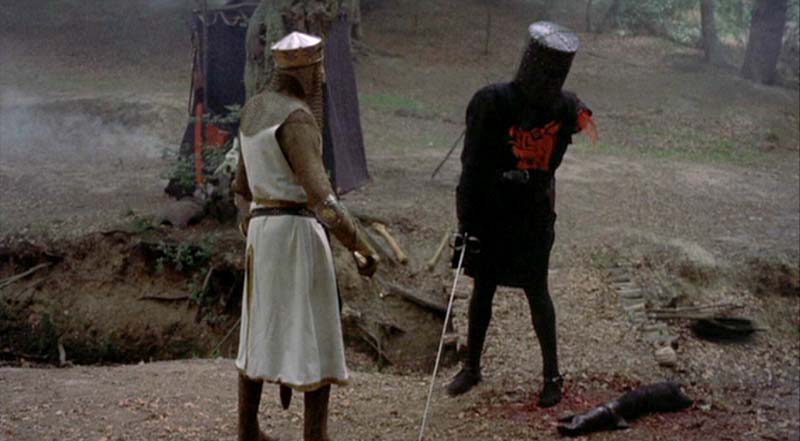
This film is laugh-out-loud funny, as it would, considering that it is Monty Python. There are many amusing scenes. The beginning is memorable ecause it starts a long row about whether coconuts migrate and the differences between African and European swallows. The Black Knight scene is just amusing for the fact somebody wants to continue fighting, even though they have lost all their limbs. "It's just a flesh wound." My favourite scene of the whole film is the French taunter scene, in which the Knights of Camelot reach a castle occupied by the French. This includes the memorable insult "I fart in your general direction. Your mother was a hamster and your father smelt of elderberries." It features all the trademarks from Monty Python's Flying Circus, from multiple roles for the main members to the cutout animations of Terry Gilliam. Michael Palin played the most roles in the film (12 in total) and surprisingly, unlike Monty Python's Flying Circus, they had women for all but one of the female roles; the Pythons were known for playing women in their sketches. Another thing I love is the fact Monty Python take something that looks completely harmless and turn it into a killing machine. In this case, a rabbit. What is amazing is the fact they were able to shoot this film whilst Graham Chapman was suffering from alcoholism.
The low budget of this film is part of the reason it is brilliant. I have alredy mentioned the use of coconut halves as horses. Another example is the first time the audience is introduced to King Arthur and Patsy. That shot was filmed on Hampstead Heath (for those who don't know where it is, it's a busy park in London). Imagine walking your dog one morning and just seeing two men pretending to ride horses, one banging together two coconut halves. Most of the castles that appear in the film are just the same one (Doune Castle in Scotland), but filmed from different angles. Another was only 10ft tall and made of plywood, which meant it kept falling over (as seen in the trailer) The costumes were also low budget. Graham Chapman was the one person who wore genuine chain mail armour; the others apparently were made of wool. However, the film was partly funded, bizarrely, by sales of Pink Floyd's The Dark Side Of The Moon. They were fans of Monty Python at the time.
The movie is still famous today, as it has been adapted into the popular Broadway musical Spamalot. It is regarded as one of the funniest movies of all time. Very few people can easily make a successful transaction from TV to film, but Monty Python achieved this, especially with the earlier success of And Now For Something Completely Different. There are so many things to love about this film, whether it is the French Taunter, the old man from scene 24 or the Knights who say "Ni!". Sorry, I mean the Knights who say "Ekki-Ekki-Ekki-Ekki-PTANG. Zoom-Boing. Z'nourrwringmm". Monty Python will always be at the height of British comedy...

Friday, June 15, 2012

My top 30 films - No.11

11. Slap Shot (1977) - "You'll see Paul Newman doing things you'd never expect him to do... saying things you'd never expect him to say!"

At the beginning of this year, there was an ice hockey movie released called Goon. I am yet to see it because there is only one thing I want to know. Is it as good as Slap Shot? The greatest hockey film ever.

The lead character in Slap Shot is Reggie Dunlop, played by Paul Newman (Butch Cassidy And The Sundance Kid), who is the player-coach of a minor league hockey team called the Charlestown Chiefs. The team is in dire straits, as they're on a losing streak and they're financially unstable because of the closure of the local mill. Eventually it is revealed that the Chiefs are to fold at the end of the season.To add to these problems for Reggie, he has to deal with the arrival of three new players - the Hanson brothers. He decides to initially leave them out of the team, because of their immaturity, their unreliability and "they brought their fuckin' TOYS with 'em!" He eventually gives them a chance and they turn out to be a bunch of violent thugs. Whilst he's not a great player or coach, Reggie is good at annoying the opposition. This includes sleeping with the wife of an opposing player and finding out something to use against him and trying to encourage some of his players to be more like the Hansons. He is also a bit of a conman and tries to keep up the team's spirits by inventing a conspiracy that they are going to be bought by a group of senior citizens in a retirement home in Florida. The only problem is that only the manager knows who owns the Chiefs. However, not everyone is won over by this new style of play. The Chiefs' star player Ned Braden (Michael Ontkean (Twin Peaks)) would prefer to play cleanly and is described by Reggie as being 'chickenshit'. It doesn't help that Ned is having troubles with his wife Lily, who Reggie keeps trying to advise. Of course he's an expert, considering that he and his wife have unofficially separated.

Let's just forget about the following two films. One of them had Stephen Baldwin in it. They just don't capture the same spirit of ice hockey that the original film did. When I'm playing dek hockey, we use lines from the film to motivate us, such as "Give 'em old-time hockey!" This film has such a cult status in the hockey world, it has made celebrities of the Hanson brothers. They are so recognisable and they turned down the chance to appear in their own spinoff film to concentrate on their hockey career. It's written by Nancy Dowd and is born out of the hockey experiences of her brother Ned, who plays a player called Ogie Ogilthorpe (me (look at the hair)). In fact, most of the cast had experience of playing hockey. Michael Ontkean turned down a contract offer to play for the New York Rangers. The majority of extras were also hockey player at the time, including current Anaheim Ducks coach Bruce Bourdreau.

One of the early name to play Reggie Dunlop was Al Pacino. However, he fell out with director George Roy Hill after he asked Pacino if he could skate. He considered that a "facetious" question and has admitted later than he regretted missing out on the role. Stick to playing Tony D'Amato in Any Given Sunday, Al. Paul Newman is fantastic in this role; in fact he said he had more fun making this movie than any other. George Roy Hill also directed Newman's other famous appearance, in Butch Cassidy and the Sundance Kid.

If you don't know any of the rules of ice hockey, watch the opening scene of Slap Shot. That's all you need. That scene is a great way to start the film, but my favourite is the one below. It perfectly illustrates why hockey is a great. More people go to hockey games to watch the fights than stay away because of them. You can away with anything in this sport, well almost. People were critical of the film early on, calling it "foul-mouthed and unabashedly vulgar". However, after repeat viewing they grew to love the film. Gene Siskel said he regretted giving the film a mediocre when he first saw it. No offence to The Rocket, Miracle or The Mighty Ducks, but Slap Shot is the greatest hockey film ever. Barry Melrose says so and he's cool, especially when he had a mullet. Don't take mine or his word for it. You'll have to watch and see.

P.S. Buy me a soda after the game...