Wednesday, November 23, 2011

My top 30 films - No.27

27. Dougal And The Blue Cat (1972)

This was one of my favourite films as a child and looking back on it, it is a masterpiece in stop motion animation. It has to be an influence on Wallace And Gromit and I loved them just as much. I am sorry if this review is shorter than some of the others, but I only found our VHS copy in the loft 3 months ago, along with some other childhood favourites.

Dougal And The Blue Cat was a feature length spin-off of The Magic Roundabout, the classic TV series from the late 60s. It features everybody's favourite characters from the TV series, including Dougal, Florence, Brian, Ermintrude, Dylan and Zebedee. One day, Dougal is rudely awakened by his cuckoo clock after what has been a very strange night and decides to go and talk to Zebedee about it. That night, he was first woken by an owl, but then he hears two voices coming from the abandoned treacle factory, particularly the words "Blue is beautiful, Blue is best. I'm Blue, I'm beautiful, I'm best!". Zebedee doesn't know what to think and questions whether or not Dougal had dreamt the whole incident. All he can suggest is that he goes and talks to Florence. However, everybody is uninterested in what Dougal has to say because of the arrival of a blue cat called Buxton. They decided that Buxton should stay at Dougal's house, despite the fact Dougal doesn't actually offer it to him. When everyone else leaves him, Buxton goes off to the factory and is met by the blue voice (Fenella Fielding). Once there, he has to pass through seven doors in order to be crowned king and decides to take over the garden. However, he underestimates Dougal.

Even though there are only two people doing the voices and you don't see the characters' lips moving, it works for me. It is like a strange fairytale, yet it does also have certain nightmarish qualities to it, especially with Fenella Fielding as the blue voice and when Buxton enters one particular room in the factory. That particular scene is what it must feel like to have a hallucinogenic trippy experience. Like The Magic Roundabout, it was written and narrated by Eric Thompson, and his grumpy attitude for Dougal struck a chord with adults of the time, as he was based loosely on Tony Hancock. As you may know, The Magic Roundabout was originally thought up by a Frenchman, Serge Danot, and he called it Le Manège enchanté. Danot originally called Dougal "Pollux", but he thought that the English had renamed it De Gaulle. In fact, many have interepted the character as representing French politicians of the time. Also, in Le Manège enchanté, the rabbit was Spanish and called Flappy. I don't know about you guys, but I prefer him being a hippy and called Dylan; we can obviously see that he was named after Bob Dylan.

I loved Dougal And The Blue Cat and it is nostalgia. Even though it was from the 70s, we had it on VHS and it was an important part of my growing up, along with the likes of Pingu, Wallace & Gromit and Thomas The Tank Engine. I love the visuals, the early stop motion animation is interesting and shows us just how far we have come. Somebody once described the film as if David Lynch had "taken over children's film making". If you haven't seen it, you'll be able to find a cheap VHS copy online, or you can buy the remastered version, which includes its French equivalent, Pollux et le Chat Bleu. When I release the up-to-date top 30 or 50 list (I haven't decided yet), this may not be in there anymore, but it is such a great piece of cinema, even if it is bizarre. I loved it before I became a teenager and, like I said, I found it in the loft 3 months ago; it hadn't changed. Watch it at least once and whilst you're watching it, just imagine David Lynch saying "I think I'm going to make a kid's programme. Let's see what happens..."

Monday, November 7, 2011

My top 30 films - An apology

As you may know, I am doing a countdown of my top 30 films. However, in the prologue, there was a tribute to great film that I had not seen and I included The Shining by Stanley Kubrick and Martin Scorsese's Taxi Driver. Since I wrote that post, I have seen both these films and this has totally messed up the original top 30 that I came up with before starting this countdown. To compensate, I will continue with the original top 30, but this was as of 1st November 2011. Then after I get to no.1, I will give a revised version of my top 30 or even 50 (depending how I feel), because there are still many great films which I haven't seen which I could before we get to no.1. I am of course talking about The Godfather trilogy, The Exorcist, The Fly, Annie Hall and (a film I didn't mention in the prologue, but hope is as good as everyone says) Raging Bull. Plus, I may end up re-watching some, so it could be not so different or change dramatically.

My short review of The Shining - another masterpiece from Stanley Kubrick, Jack Nicholson's performance is psychotic and memorable, mind you the scene with the naked lady in the bath is disturbing
My short review of Taxi Driver - Robert De Niro's stand-out performance, what a chilling piece of cinema, features memorable soundtrack by Bernard Hermann and perhaps one of the greatest movie quotes ever - "You talkin' to me?"

Wednesday, November 2, 2011

My top 30 films - No.28

28. In The Loop (2009) - "Things are about to spin out of control."

Over 135 uses of the f-word, at least two mentions of c*** and other constant profanities and insults crammed into a 106 minute British satirical black comedy. Only we could have this much swearing in a movie and make it so hilarious.

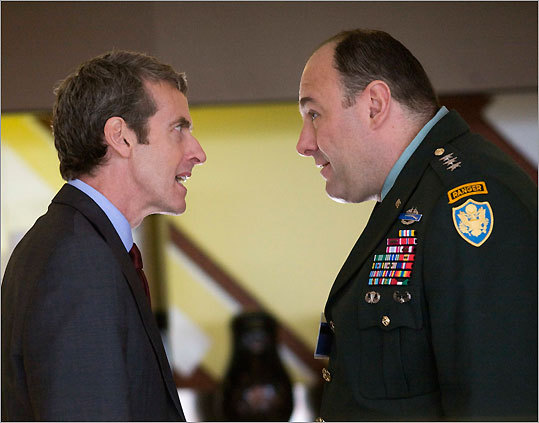
As you may know, In The Loop is a spinoff of the TV series The Thick Of It, which satirises how the modern British Government works. Both of them were written by comedian Armando Iannucci, who was a fan of the political sitcom Yes Minister from the 1980s. He described The Thick Of It as "Yes Minister meets Larry Summers". Both of them star Peter Capaldi as the violent, foul-mouthed Scot that is Malcolm Tucker, the Prime Minister's Director of Communications. He is outraged after the Minister for International Development Simon Foster (Tom Hollander) haphazardly tells BBC Radio 4 that a proposed war in the Middle East is "unforeseeable". Malcolm tries to ban Simon from any media appearances until he can be trusted to "keep the line". However, Simon encounters the press later that day and says "To walk the road of peace, sometimes we need to be ready to climb the mountain of conflict." Malcolm's response to this is one of my favourite lines in the film - "You sounded like a f****** Nazi Julia Andrews!" He decides to send Simon and his aide Toby (Chris Addison) to Washington, D.C. to be "room meat" whilst many of America's key political and military figures discuss the cases for and against war. However both sides want to use Simon in their favour and he has no idea what to do. He, to some extent, is representing the audience, so we imagine what would happen to us in that situation. Despite the fact they are on the verge of war, there are issues closer to home for him, which could damage his reputation as a minister further.

Apart from Peter Capaldi, most of the cast from The Thick Of It appear in the film, including Chris Addison, Alex MacQueen, James Smith and Joanna Scanlan. However, the only returning characters from The Thick Of It are Malcolm and Jamie McDonald (Paul Higgins), Senior Press Officer in the Office of the Prime Minister and "the crossest man in Scotland", but those who also appeared in it are essentially playing the same characters, but with different names and jobs. I like that because you would rather want somebody in a spinoff who you are familiar with from the original series. Plus, the characters they are playing in In The Loop aren't that different to those they played in The Thick Of It. Other cast members include Gina McKee, Mimi Kennedy, James Gandolfini (The Sopranos) and
Steve Coogan, who Armando Iannucci worked with before on I'm Alan Partridge.

One of the filming techniques used was to film each scene twice. The first time is meant to be a word perfect version of the final script, because it was written by five people - Iannucci, Jesse Armstrong, Simon Blackwell, Tony Roche and Ian Martin. The second time the actors add their own words to it and the camera is following them, instead of them following the camera, so you are able to see the changes in expressions very easily. There are many scenes where the audience can see a look of fear on the characters' faces or when Malcolm is wanting to give someone a b******ing.

The plot of this film satirises Anglo-American politics, particularly around the time of the invasion of Iraq. You can relate to the fact that Britain and the United Nations got dragged into the war in Iraq by America and it's much the same in this film, especially when the Americans use Simon's infamous words - "climb the mountain of conflict." There is one scene where they've typed that out in a variety of different fonts and Toby suggests that they use the style associated with the SS. Apparently, some of the bizarre scenes in the movie aren't that different to what actually happened. Were there meetings between key official in some child's bedroom whilst there was a formal reception downstairs? But one of the other things that is satirised is the reason why this film and the TV series are brilliant. There is popular belief that Malcolm is based mainly on Alastair Campbell, who was Tony Blair's Director of Communications. They both have a reputation for shouting their heads off at people, constant swearing and Alastair Campbell admits to doing something that Malcolm does in the film, which is talking on two mobile phone at the same time, even though he didn't like it. Peter Capaldi actually believes that in some cases he shares the same qualities as "Lord" Peter Mandelson and some of the other great spin-doctors in history.

Malcolm Tucker should go down as one of the greatest characters in TV/film history. The Guardian compared him to the likes of Rigsby, Basil Fawlty and Edmund Blackadder. Johnny Dee said "It's not just the brilliance of these creations that links these comedy giants, the pathos of all four men comes from their resigned certainty that they alone know what they are doing amid a sea of fools." He's one of those characters which you don't often see, but when you do they stand out. There's a reason why there are five writers and they allow Peter Capaldi to add his own words. How many writers can come up with great outbursts such as "This is a government department, not some f****** Jane f****** Austen novel! Allow me to pop a jaunty little bonnet on your purview and ram it up your s****** with a lubricated horse c***!" and "We burned this tight-arsed city to the ground in 1814. And I'm all for doing it again, starting with you, you frat f***. You get sarcastic with me again and I will stuff so much cotton wool down your f****** throat it'll come out your arse like the tail on a Playboy bunny"? I'm not interested in politics and probably never will be, but some of the best films take a subject that might not appeal to you , put on the screen in the most entertaining way and you're hooked. It's Britain's version of The West Wing, but ruder, funnier, swearier and with a demented Scot...